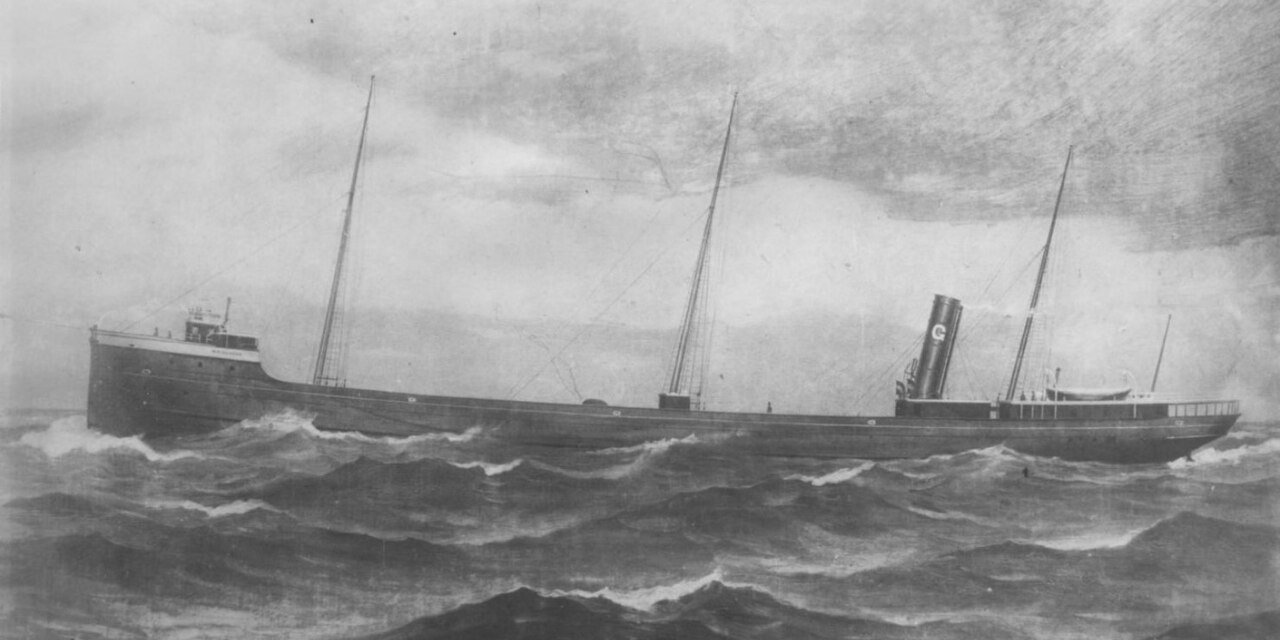
Every autumn the Great Lakes remind sailors who is in charge. In late October 1892 a two-day gale tore across Lake Michigan and Lake Huron, and when it finally blew itself out, one of the newest and largest freighters on the lakes had simply vanished. The steel steamer W.H. Gilcher had passed through the Straits of Mackinac that afternoon, and nobody aboard her was ever seen alive again. Over the years her story picked up a ghostly postscript: local lore says she still steams out of the fog near Mackinac Island. As always, I’ll give you the documented history first, then the legend, and I’ll be clear about where one ends and the other begins.
A modern steel giant
The W.H. Gilcher was built in Cleveland by the Cleveland Shipbuilding Company and completed in May 1891 for the Sandusky firm of Gilchrist, Gilcher & Schuck. She was named for William H. Gilcher, one of the owners. Her official register length was 301.5 feet between perpendiculars (some lists give about 318 feet overall), with a beam of about 41 feet, and she measured roughly 2,415 gross tons. She cost around $200,000, a serious sum at the time.
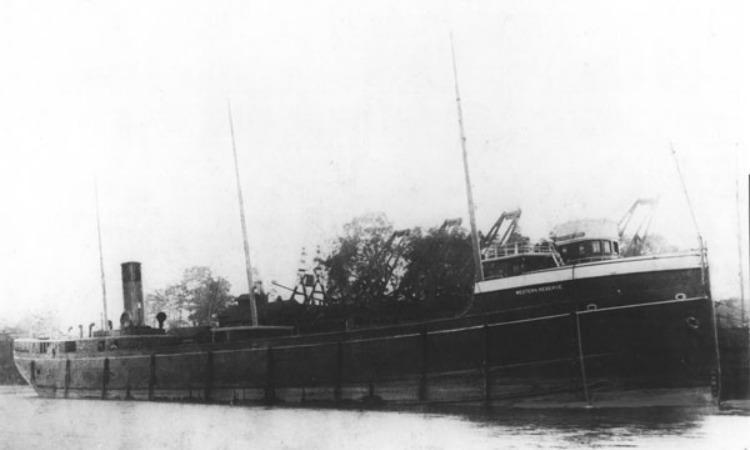
What made her special was the material. The Gilcher and her near-twin, the Western Reserve, built at the same yard, were among the first lake freighters made of steel plate rather than wood or iron. Steel let builders make bigger hulls that could carry heavier loads, and the Gilcher showed it off. In September 1892 she brought 113,885 bushels of wheat from Chicago to Buffalo, a record grain cargo at the time, and that same month she set a record for coal delivered into Chicago. She wasn’t trouble-free; in her short career she went aground after her wheel chains parted and broke her wheel in the ice at Duluth. But by the autumn of 1892 she was a proud, record-setting ship barely eighteen months old.
A warning two months earlier
On August 30, 1892, the Western Reserve, the Gilcher’s near-twin, broke in two in a gale on Lake Superior, some 60 miles above Whitefish Point. Her owner, Captain Peter G. Minch, was aboard with his family. Of everyone on board, only one man, wheelsman Harry W. Stewart, made it to shore alive. It was a shocking loss for a brand-new steel ship, and it would look even worse within two months.
The last voyage
On October 26, 1892, the Gilcher left Buffalo with about 3,080 tons of coal bound for Milwaukee. She was under the command of Captain Leeds H. Weeks of Vermilion, Ohio, a master that the 1899 History of the Great Lakes described as “of undoubted seamanship and experience.” The trip up Lake Erie and Lake Huron seems to have been uneventful. At about 2:30 in the afternoon of Friday, October 28, she was reported passing through the Straits of Mackinac into Lake Michigan.
That was just as the weather turned. By midnight a northwest gale of 60 to 70 miles an hour was blowing across the lakes. It sank and stranded vessels from Cleveland to Lake Superior, and it would blow for two days.
At about 8 p.m. that Friday, Captain Duncan Buchanan of the schooner Seaman saw a big steamer in the vicinity of North Manitou Island. Accounts of exactly where differ a little (one says about 20 miles northeast of North Manitou and 15 miles west of the Fox Island light, another says northwest of North Manitou), but Buchanan reported passing within about 300 feet of her, close enough that he was sure of her identity. She had her bow pointed into the wind and seemed to be struggling. That’s the last confirmed sighting of the W.H. Gilcher.
There was one more strange report. When the steamer Waukesha reached Port Huron on November 2, her captain said that while passing Fox Island he had seen the lights of a big steamer suddenly go out.
Wreckage, but no ship
When the Gilcher didn’t arrive in Milwaukee, worry turned to dread as other ships came into port. Captain George Dennis of the schooner John Shaw reported sailing through a large field of wreckage near the Manitou Islands, including furniture and part of a bridge floor. The steamer White and Friant picked up pieces of a pilot house. From November 3, furniture and other wreckage bearing the Gilcher’s name began washing ashore on North Manitou Island. There were no survivors.
The same storm claimed a second vessel in the same waters. The schooner Ostrich, a smaller sailing ship, was found cast up almost bottom side up on the beach. Mansfield’s History of the Great Lakes (1899) reported that wreckage from the Ostrich and the Gilcher lay on the beach “not 100 feet apart.”
Mansfield also recorded a grim detail. Captain Stuffelbaum of the steam barge Hattie B. Perene examined wreckage on High Island that included the frames that held the canvas covers over the Gilcher’s lifeboats. They had been cut with an axe, as if the crew had rushed to the boats in great haste and didn’t have time to take the covers off the normal way. The lifeboats themselves were never found, which suggested the steamer went down before they could be freed.
On November 18 it was reported that two bodies wearing Gilcher life preservers had been found on Fox Island, along with the steamer’s mizzenmast. They were later recovered by the tug Onward and brought to Traverse City on January 3, 1893. One of the dead was identified as the steward, Charles E. Williams.
What sank her?
No one survived to explain what happened, so theories filled the gap.
A collision. Mansfield wrote in 1899 that “the most acceptable view” was that the Gilcher collided with the Ostrich in the storm. The two wrecks washing up side by side made the idea attractive, but it was never proven.
Bad steel. Losing two nearly identical new steel freighters in about 60 days raised hard questions. Steel had become cheap thanks to the Bessemer process, but that process left little time to control the metal’s chemistry. Phosphorus and nitrogen left in the steel could make it brittle, less able to handle the constant flexing a long hull suffers in heavy seas. People suspected that the Gilcher, like the Western Reserve, may simply have broken apart. That theory can’t be proven either without the wreck.
The storm itself. A loaded freighter caught in a two-day northwest gale in open water would have been in serious danger whatever she was made of.
Even the number of people lost isn’t certain. Sources disagree: Mansfield gives a crew of 16, the Historical Collections of the Great Lakes record at Bowling Green State University lists 18, and other compilations range anywhere from about 17 to 22. “About twenty souls” is the safest way to put it. The crew lists name men from Vermilion, Lorain, Cleveland, Buffalo, Chicago, and especially Marine City, Michigan, which lost several, including two pairs of brothers.
Has the wreck been found?
As far as I can find, no. After the car ferry Pere Marquette 18 was discovered in 2020, the W.H. Gilcher became the largest shipwreck in Lake Michigan whose location is still unknown. Somewhere out there, probably in the deep water around the Manitou and Fox Islands, a 300-foot steel steamer is still waiting to be found.
The legend: the Gilcher in the fog
Here’s where we leave the records behind. In Great Lakes ghost-story collections, the Gilcher is often described as a “coal steamer lost in the Straits of Mackinac.” In the version usually told, she steamed into a strange bank of fog and was never seen again. Local lore says she still appears in fog near Mackinac Island, a dark steamer that comes out of the mist and slips back into it.
I want to be honest about how thin this is. I couldn’t find any named witnesses, dates, or early sources for the sightings. They show up in modern collections of ghost stories rather than in newspapers from the time. And the legend’s geography doesn’t match the record. The Gilcher did pass through the Straits that afternoon, but she was seen hours later by the Seaman, far to the southwest near the Manitous, and her wreckage came ashore on North Manitou, the Fox Islands, and High Island. If she haunts anywhere, the evidence would put her ghost out in northern Lake Michigan, not off Mackinac Island.
Still, it’s easy to see why the story attached itself to the Straits. That was the last place many people knew she had been, and the Straits are famous for their fog and their wrecks. For many people “lost at the Straits” turned into “lost in the fog.” A brand-new ship, a captain known for his skill, a crew of about twenty, and not a single answer. A story like that tends to grow a ghost.
Visiting the Gilcher’s waters
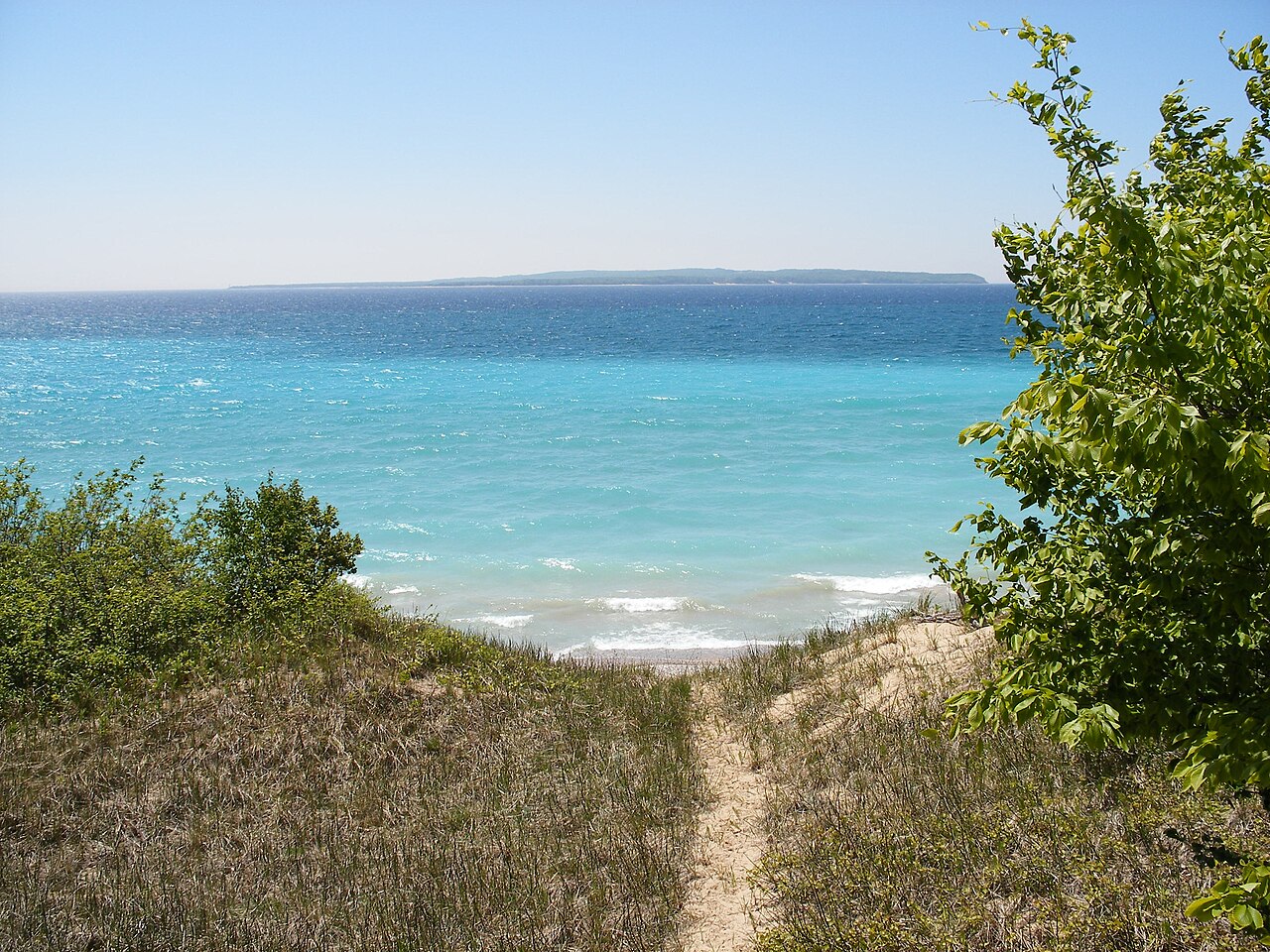
You can’t visit the wreck, but you can visit the places in her story. North and South Manitou Islands are part of Sleeping Bear Dunes National Lakeshore, and seasonal ferries run from Leland. North Manitou has a historic U.S. Life-Saving Station, a good reminder of how dangerous these waters were. Mackinac Island and the Straits are easy to reach by ferry from Mackinaw City and St. Ignace. And if you’re on the water up there on a foggy autumn evening and see the lights of a big steamer that suddenly go out, well, you’ll know which story to tell.
Quick facts
When did the W.H. Gilcher sink?
On or about October 28, 1892, during a two-day gale on northern Lake Michigan.
Were there any survivors?
No. Everyone aboard was lost; sources give anywhere from 16 to 22 crew, most often about 18.
Is the Gilcher a ghost ship?
Only in legend. Local lore says she appears in the fog near Mackinac Island, but those sightings are poorly documented.
Top image: The W.H. Gilcher, painted by Howard Freeman Sprague, 1892. Painting: Howard Freeman Sprague, public domain, via Wikimedia Commons