Some ghost ships come with a name, a date, and a stack of newspaper clippings. This one doesn’t. The phantom schooner of Saginaw Bay is a story that has been told around Lake Huron for generations: a cruel captain, a frayed rope, a dying curse, and a three-masted schooner that sailed out of the bay and never came back. I’m going to tell it the way it’s usually told, without a ship’s name, and then I’ll be honest about what we can and can’t check, and give you some real Saginaw Bay history and tips for visiting.
Saginaw Bay: the setting
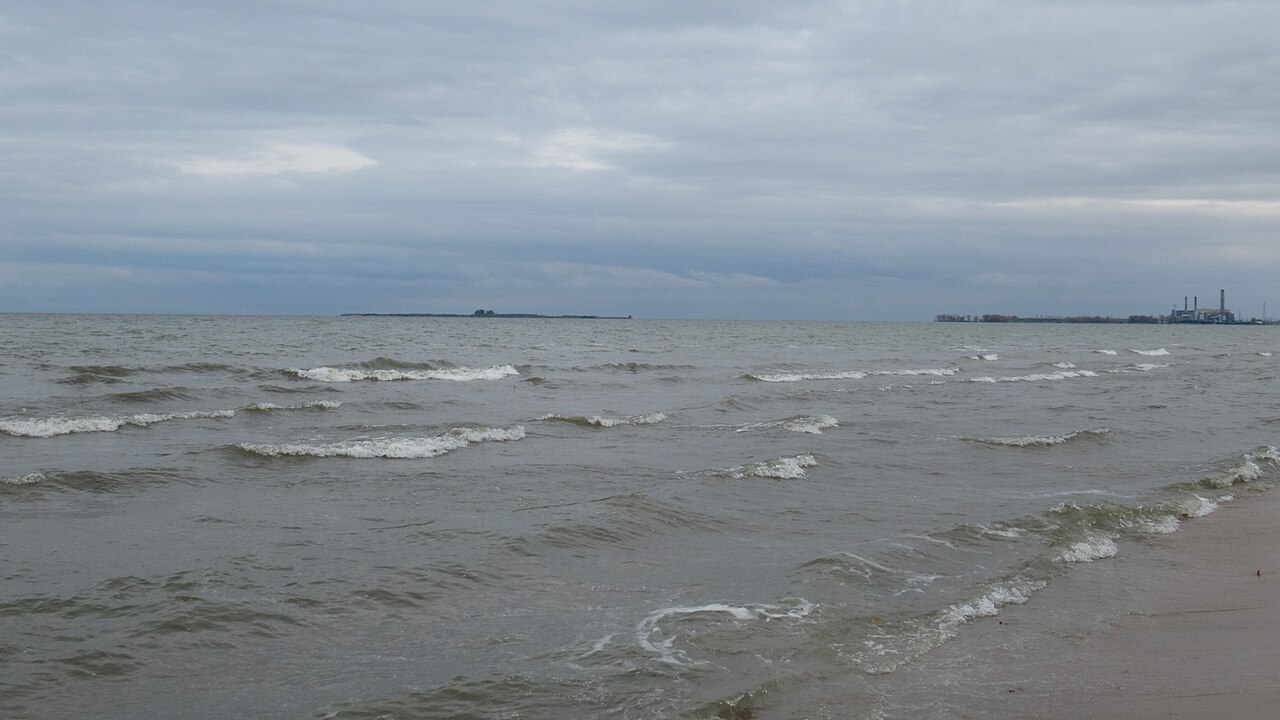
If you look at a map of Michigan’s mitten, Saginaw Bay is the gap between the thumb and the rest of the hand. It’s a big bay, about 1,143 square miles, opening northeast into Lake Huron and touching five counties: Arenac, Bay, Huron, Iosco, and Tuscola. The Saginaw River flows into it at Bay City. The name “Saginaw” may come from Ojibwe words meaning something like “to flow out,” a possible reference to that river.
The bay’s watershed is the largest drainage basin in Michigan, covering roughly 15 percent of the state’s land area, and it holds the largest contiguous freshwater coastal wetland system in the United States. People lived along these shores long before any schooner arrived; by the time Europeans came, it was Ojibwe country. The first European known to visit the Saginaw Bay area was the French Jesuit missionary Father Jacques Marquette, in 1668.
In the 19th century the bay was busy. Michigan’s lumber boom poured timber down the Saginaw River and out across the Great Lakes, and the bay filled with schooners, steamers, and tugs. To guide them, the government built the first Saginaw River lighthouse between 1839 and 1841. After the river was dredged for larger ships in 1867, a new pair of range lights replaced it in 1876.
That’s the world of our story: a crowded, working bay full of sailing ships, where a calm summer day could leave a schooner sitting still on the water for hours.
The legend of the phantom schooner
The story is set in 1883. A three-masted schooner was bound for Cleveland to take on a load of coal. Somewhere in Saginaw Bay the wind died, and she sat becalmed, her sails hanging slack.
Sailors hate a calm almost as much as a storm, and the captain decided to use the time for work aloft. He ordered one of the crew up the mast. According to most tellings he was a young man, new to the ship. He was to be hauled up in the boatswain’s chair, the simple seat on a rope that sailors used to work high in the rigging.
The trouble was that everyone aboard knew the rope on that chair was frayed. The crew knew it wasn’t safe. The captain sent him up anyway.
Partway up, the rope snapped. The young sailor fell to the deck. As he lay dying, he cursed the captain who had sent him up.
And then, the story goes, he didn’t leave. For three days afterward the crew saw a white form on deck. It would appear and then settle on the spot where he had fallen, as if he were lying there again. The men were badly shaken, and some say the figure was seen in the cabins too.
When the schooner reached port, much of the crew quit. They told anyone who would listen what they had seen. The captain found new hands, the schooner took on her coal, and she sailed back out into Lake Huron.
She was never seen again. No wreckage, no survivors, no word.
Except, the legend says, she has been seen, just not in a way anyone can explain. For generations people have reported a dark three-masted schooner in Saginaw Bay that seems to appear out of nowhere and then simply vanishes. Some say she’s still trying to make port. Others say the young sailor’s curse sank her and keeps her sailing.
Can we trace the story?
This is where I have to be honest. I haven’t been able to match the details of this legend to any record I can verify. The versions I’ve found appear in modern collections of Great Lakes ghost stories, retold from earlier ghost-story books, rather than in newspapers or shipping records from the 1880s. There are no named witnesses to the fall or the white figure, and no specific accounts of the later sightings.
That doesn’t mean there’s nothing behind it. Schooners really did vanish on Lake Huron in the 1880s, sailors really did fall from the rigging, and crews really did refuse to sail on ships they thought were unlucky. Sailors were famously superstitious, and a death aboard was the kind of thing that could empty a ship of its crew. A story like this may have grown from a real accident, a real disappearance, or several of them blended together over many tellings.
So treat it as what it is: a legend handed down for generations, with a kernel that sounds very much like real life on the lakes, and details that can’t be pinned down. That’s why I’m telling it without a name. The story is the ghost here.
Lighthouses of Saginaw Bay
If you want to go looking for the phantom yourself, the bay’s lighthouses are the place to start.
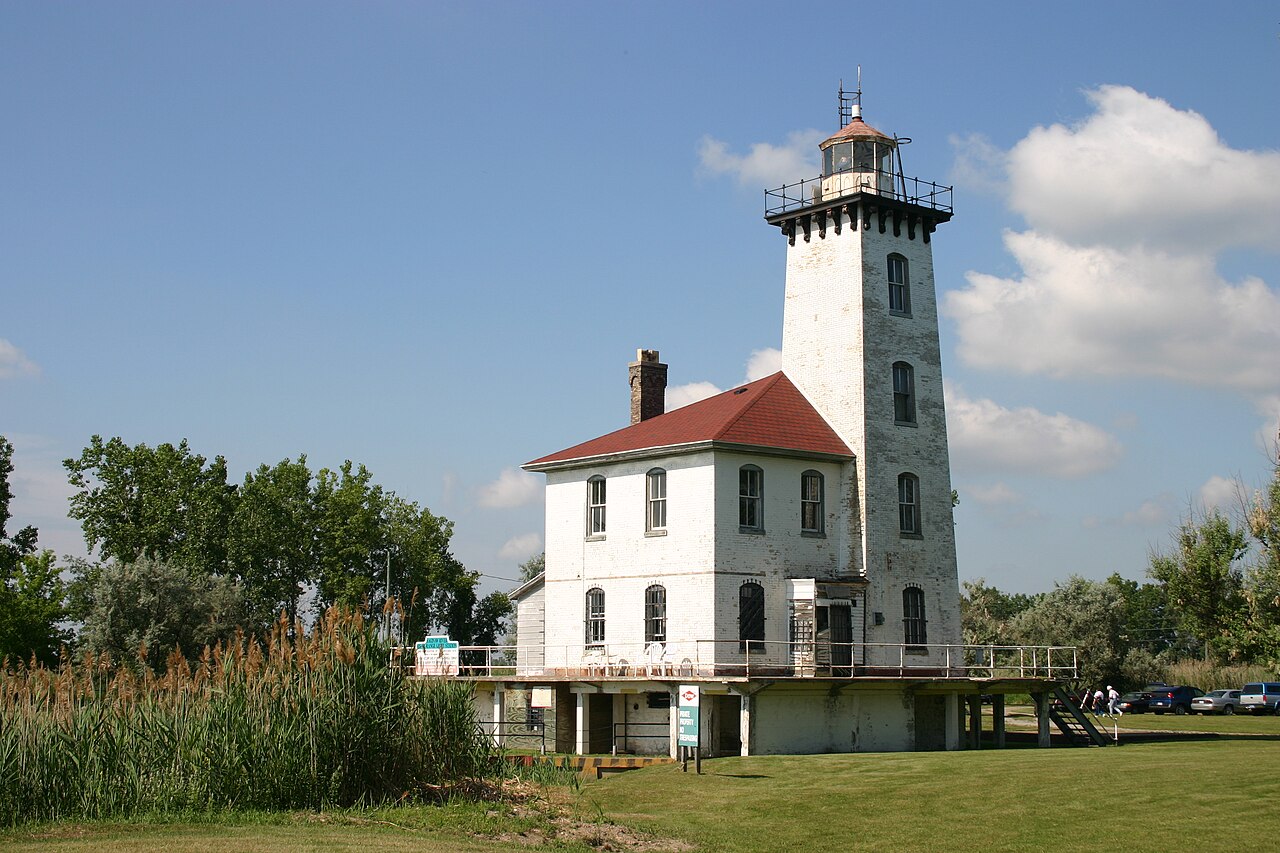
Saginaw River Rear Range Light (Bangor Township, near Bay City). Built in 1876 to a design by district engineer Major Godfrey Weitzel, this is a square, tapered tower of Cream City brick rising out of a two-story keeper’s dwelling. Range lights work in pairs: when a captain saw the front and rear lights lined up one above the other, he knew he was on the right line into the river channel. The front light was a timber tower on the river bank; the rear light stood about 2,300 feet south of the river mouth. It’s often said, though not well documented, that this was the first place in the country where range lights were used. The light was converted to electricity in 1915 and was deactivated in 1960. It was listed on the National Register of Historic Places in 1984, and since 1999 the Saginaw River Marine Historical Society has been working to restore it. It sits on private industrial land, so check the society’s current tour schedule before you go rather than just turning up.
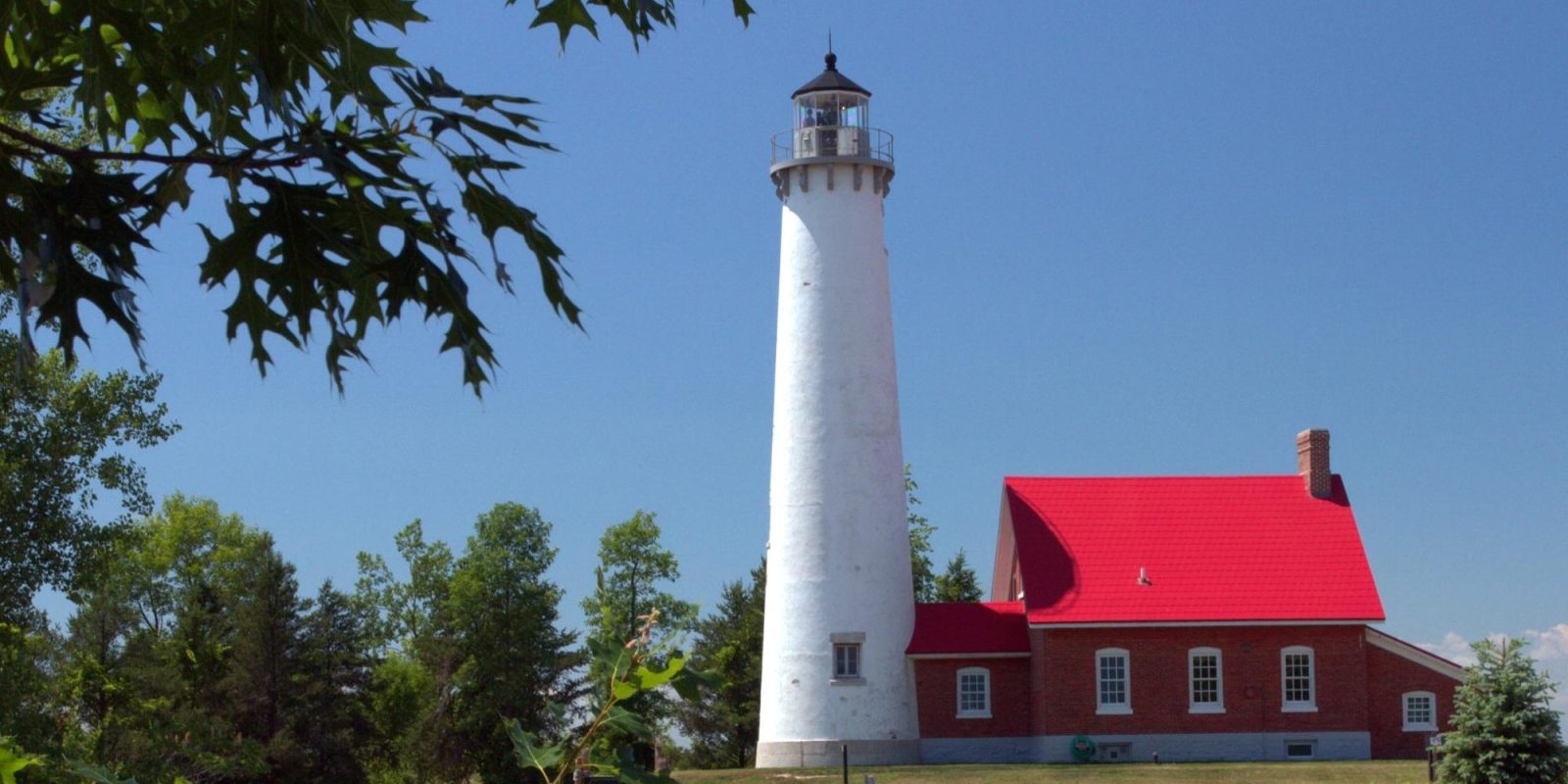
Tawas Point Lighthouse (East Tawas). On the northern edge of the bay, the Tawas Point light station dates back to 1853, and the present tower is a white conical brick lighthouse of about 67 feet. It’s in Tawas Point State Park, and it’s one of the easier Saginaw Bay lighthouses to visit.
Pointe aux Barques Lighthouse (near Port Hope). At the tip of the thumb, marking the eastern side of the bay’s mouth, this light has watched over the turn between the bay and open Lake Huron for well over a century.
Visiting tips
Bay City State Park. On the shore near the mouth of the Saginaw River, this park gives you wide views over the bay. On a still, hazy evening it’s easy to imagine a schooner sitting becalmed out there.
Go at the right time. The legend begins with a calm, so a windless, misty day is perfect. Early morning and dusk are best for atmosphere. Fall brings fog and fewer crowds; summer brings easier access to the lights and parks.
Respect the water. Saginaw Bay is fairly shallow in many places, and conditions can change fast. If you’re going out by boat, check the marine forecast.
Check before you go. Lighthouse tours and opening hours are seasonal and run largely by volunteers, so confirm times with the park or historical society.
Quick facts
Does the phantom schooner have a name?
Not in this telling. The story has been passed down for generations, and its details can’t be confirmed in records, so I’ve told it as a legend.
Where is she said to appear?
In Saginaw Bay, on Lake Huron. People describe a dark three-masted schooner that appears and then vanishes.
Where can I see Saginaw Bay’s maritime history?
At the Saginaw River Rear Range Light near Bay City, Tawas Point Lighthouse in East Tawas, and Pointe aux Barques Lighthouse near Port Hope.
Top image: Tawas Point Lighthouse on Saginaw Bay, East Tawas, Michigan. Photo: Myron Reynard, CC BY 2.0, via Wikimedia Commons