Most of the ships on this site come with a ghost attached: a phantom light, a figure on deck, a vessel that sails out of the fog and vanishes. This one doesn’t. I went looking for a ghost story about the steamboat Timour No. 2, and I couldn’t find a single recorded sighting. No phantom paddlewheel, no lantern on the water, no figure on the riverbank. What I found instead was one of the worst disasters ever to happen within sight of Missouri’s capital, and an eyewitness who said the sound of it never left him. If any wreck deserves to haunt Jefferson City, it’s this one.
A busy river below the capitol
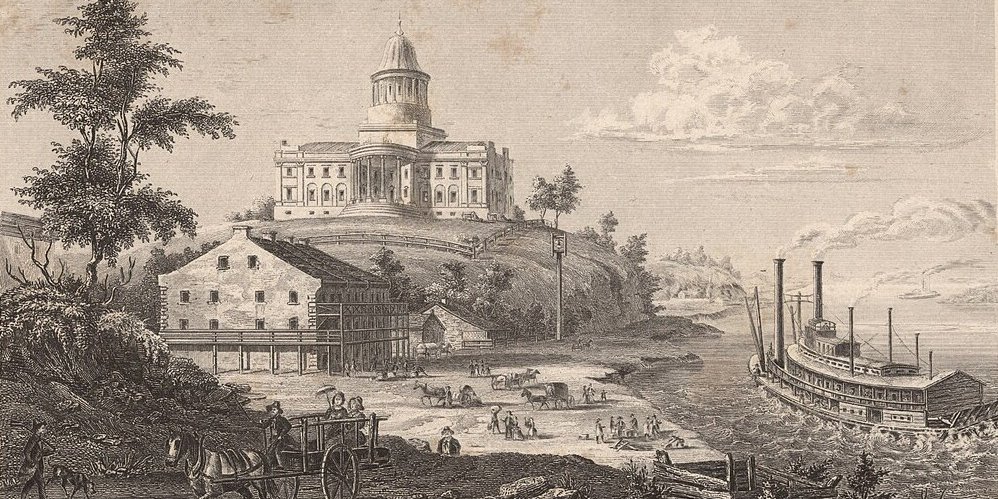
In the 1850s, the Missouri River was the highway of the West, and Jefferson City sat right on it. Before the first bridge went up in 1896, the only way across the river here was by boat. The town had several landings, including the Harrison Street Landing, which handled freight, packet steamers, and the ferry to the Callaway County side, and Jefferson Landing, which handled the most freight.
It was also a dangerous river. Steamboats on the Missouri tended to last only four or five years. Snags (whole trees stuck in the riverbed) ripped open hulls, ice crushed them, fires burned them, and boilers blew them apart. According to a 2022 Jefferson City News Tribune history column, Army Corps of Engineers maps based on the records of two river historians, Hiram Chittenden and Dr. E.B. Trail, show 29 wrecks within 30 miles up and down the river from Jefferson City. Sixteen of those boats hit snags. Two exploded. The worst of all, the column says, was the Timour No. 2.
Taking on wood, late August 1854
The exact date depends on which source you read. A Hannibal history column quoting an 1854 newspaper gives August 26. An old Missouri River account reprinted from the Burlington Saturday Evening Post says August 29. The News Tribune column says September 24, which doesn’t fit with newspaper reports from early September. KRCG’s “Time and Again” series simply calls it a hot Saturday in late August. So I’ll say “late August 1854” and leave it there.
What the sources agree on is the scene. The Timour No. 2 was tied up at Edward’s wood-yard, about three miles below the Jefferson City docks, taking on wood for her boilers. That was a routine stop. Steamboats burned huge amounts of wood, and wood-yards along the bank kept them supplied.
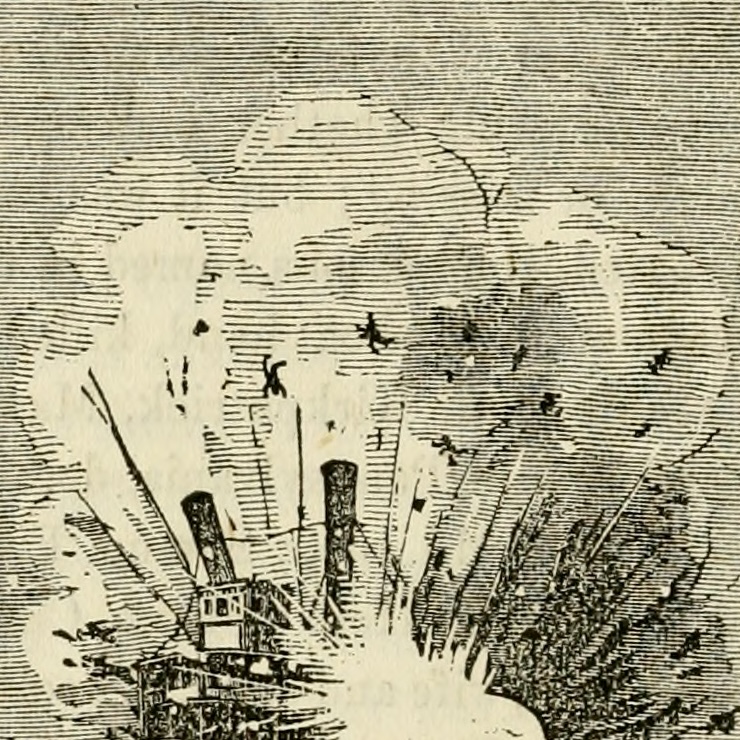
Then all three of her boilers exploded at once.
The blast destroyed the whole front of the boat, as far back as the wheelhouse. What was left sank almost immediately. Two of the boilers were thrown onto the railroad track along the shore, and pieces of the boat were found half a mile away.
The boy on the levee
Up at Jefferson City, a 16-year-old named Philip E. Chappell was standing on the levee, probably at the Harrison Street Landing, waiting for the ferry home to the Callaway County side. He had been watching the steamboat downriver. He saw it disappear into a cloud of steam and smoke and heard the explosion. When the cloud cleared, the boat was gone.
Chappell and the ferryman jumped into a skiff and rowed as hard as they could. They were the first to reach the wreck. More than fifty years later, he described what he found:
“The shrieks and groans of the dying, and their piteous appeals that they be put immediately out of existence, to end their sufferings, were heartrending, and resound in my ears to this day, although more than half a century has passed.”
He also wrote that the survivors were so badly scalded they hardly looked human. It’s a hard passage to read.
And here’s the surprising part. That experience didn’t drive Chappell away from the river. He became a steamboat owner and ended up running a whole line of boats on the Missouri and Osage rivers. Later he served two terms as mayor of Jefferson City and was Missouri’s state treasurer from 1881 to 1885, before moving to Kansas City and going into banking. He died in 1908.
How many died?
Nobody knows exactly, and nobody ever did. Many of the victims were blown into the river and never seen again. The injured were taken to the Sisters’ hospital in Jefferson City, where several more died. KRCG, citing the New York Times of September 6, 1854, puts the final count at about 17 to 20 dead out of the 47 people who left St. Louis on the boat. The Hannibal column says estimates at the time ranged from 12 to 20. Early reports quoted in the News Tribune counted six dead on shore, 17 scalded or injured, and 15 or 16 thrown overboard and drowned. The older Burlington account says “more than thirty,” but it was written long after the fact.
Among those reported killed were the clerk, Charles Eckler, whose family was aboard (two of his children were badly scalded), and Charles Dix, the captain’s brother.
Did the captain survive?
This is where the sources disagree. Early newspapers reported that Captain Edmund F. Dix was killed. A Hannibal paper said he was blown into the river “and afterwards taken out dead,” and KRCG lists him among the victims. But the News Tribune column says that, contrary to those reports, Dix survived, and that he and the boat’s engineers testified at an inquiry into the explosion. I can’t settle that from here, so I’m giving you both versions.
One survivor we know about for sure is Joseph E. Buchanan, a 21-year-old “striker” (an engineer’s helper) from Hannibal. He was badly hurt and taken to St. Louis, but he recovered and gave a statement. He said he had been feeding water to the boilers for about three hours, that the boat usually carried about 140 pounds of steam, and that everything seemed to be working normally.
The inquiry heard from many witnesses and found that the boilers had exploded from “an unknown and unforeseen cause,” without negligence by the crew. The men were cleared.
What’s left in the river
The wreck never really went away. The old Burlington account, written by a riverman many years later, says the hull of the Timour lay partly on the riverbank and was almost completely out of the water during very low water.
That same account tells a story I have to pass along with a warning label. It says the boat’s safe, “which contained a large amount of money,” was blown to the top of a bluff 200 feet high. I haven’t found that in any 1854 report, so treat it as a story told in an older account, not a confirmed fact.
So why no ghost?
By all the usual rules, the Timour No. 2 should be haunted. A sudden, violent disaster. Victims never found. A wreck that shows itself when the river drops. A witness who said he could still hear the screams half a century later.
But I couldn’t find any recorded sightings, and I’m not going to invent one. The closest thing is in Janice Tremeear’s 2012 book Haunted Jefferson City (Arcadia/The History Press), which refers vaguely to the graves of steamboat crews in the river. It doesn’t tell a ghost story about the Timour.
Maybe that’s the most haunting part. The only voices from that day that we have are real ones, like Chappell’s, still ringing in his ears fifty years later.
(One note to avoid a mix-up: the steamboat Montana, whose wreck is sometimes seen at low water, sank near St. Charles and Bridgeton, far downriver, not at Jefferson City. She isn’t part of this story.)
Visiting the Jefferson City riverfront
You can’t visit the wreck site itself. It’s on a working river, and the wood-yard is long gone. But you can stand where Chappell stood, more or less, and look downriver.
Jefferson Landing State Historic Site. Right below the capitol, this is the old river landing, with the 1830s Lohman Building and the Union Hotel. It’s the easiest place to get a feel for the steamboat era.
The Harrison Street Landing area. According to KRCG, traces of the old landing can still be seen near the foot of Harrison Street, including the remains of a boat ramp and old iron “A-frame” dock anchors. These are later than 1854, but this is roughly where Chappell’s ferry left from.
Missouri State Capitol. The capitol sits on the bluff above the river, and the grounds have good views up and down the Missouri. The Missouri State Museum inside covers state history, and free guided tours are usually offered.
Katy Trail. The Katy Trail State Park runs along the north side of the river. You can reach it from downtown by the bike and pedestrian lane on the Missouri River bridge to the trailhead in North Jefferson, then walk or ride along the river bottoms.
Check before you go. River levels, trail conditions, and museum and tour hours change, so check with Missouri State Parks and the capitol before you plan a trip. If the river is very low, you’ll see just how much it hides.
Quick facts
When did the Timour No. 2 explode?
In late August 1854. Sources give August 26 or August 29, and one modern column gives September 24.
Where did it happen?
At Edward’s wood-yard, about three miles below Jefferson City on the Missouri River.
How many people died?
About 17 to 20 of the 47 aboard, according to KRCG, though estimates at the time varied and many bodies were never recovered.
Is the Timour No. 2 haunted?
There are no recorded ghost sightings. It’s a real disaster that, by every usual rule, should have a ghost story.
Top image: Jefferson City and the Missouri River, engraving published by Hermann J. Meyer, c. 1850–53. Image: Hermann J. Meyer (publisher), public domain, via Wikimedia Commons