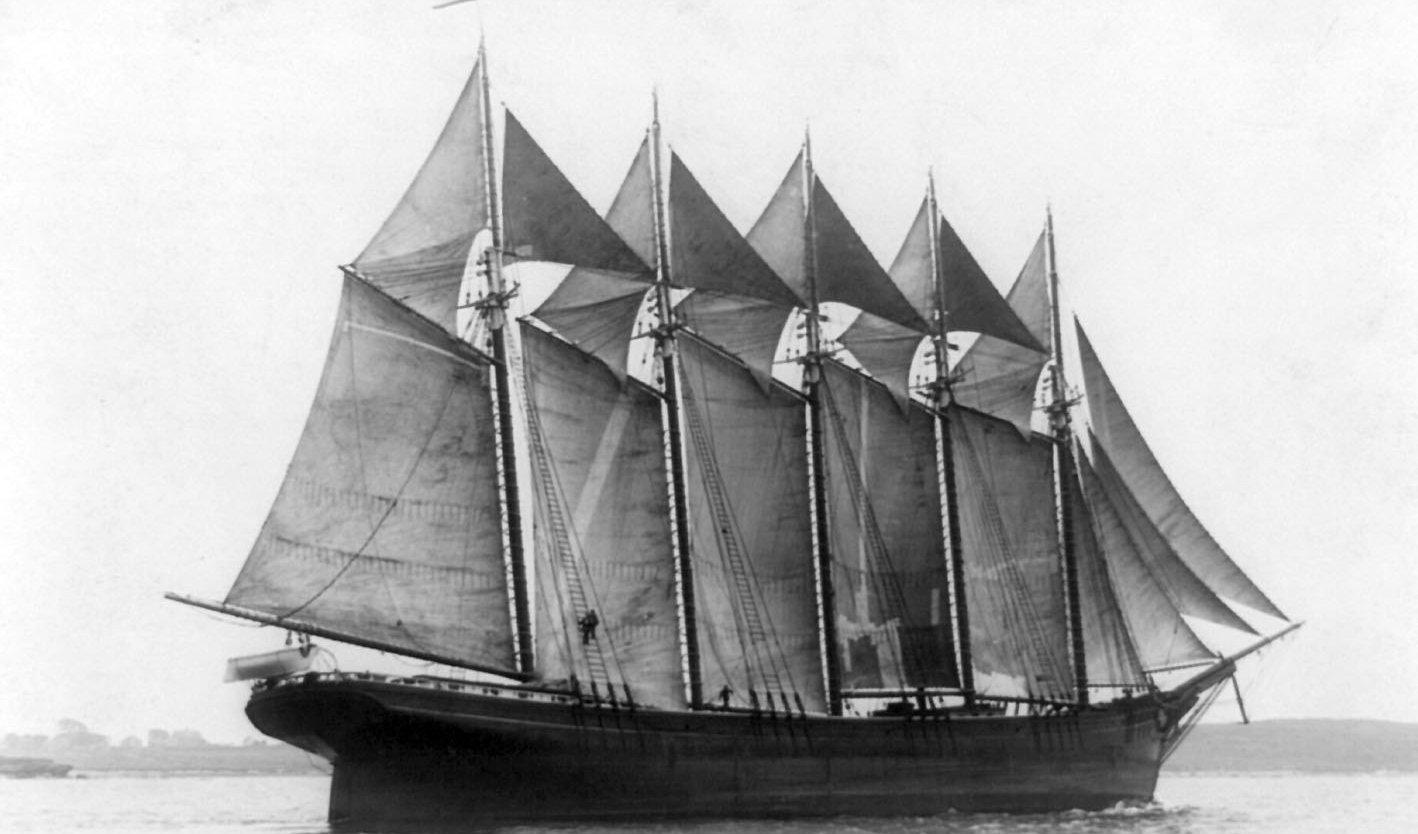
Most of the ships on this site come with a ghost attached: a phantom light, a figure on deck, a vessel that sails out of the fog and vanishes. The Carroll A. Deering is different. Nobody has ever reported seeing her crew walking the beach at Hatteras, and I couldn’t find a single recorded apparition. What she has instead is something stranger and more stubborn than a ghost story: eleven men who simply vanished, a ship found with food still on the stove, and a federal investigation that ended without an answer. A century later, the "Ghost Ship of Diamond Shoals" is still haunting the people who try to solve her.
Dawn on Diamond Shoals
At about 6:30 on the morning of January 31, 1921, surfman C.P. Brady of the Cape Hatteras Coast Guard Station looked out toward Diamond Shoals, the shifting sandbars that reach out into the Atlantic off Cape Hatteras, North Carolina. There, stuck fast on the outer shoals, was a big five-masted schooner. Her sails were all set, as if she were still under way. She was the Carroll A. Deering, and as the Coast Guard would soon discover, there was no one aboard to explain how she got there.
Diamond Shoals had earned its reputation long before 1921. The waters off the Outer Banks are known as the Graveyard of the Atlantic, and heavy seas kept would-be rescuers away from the stranded schooner for days.
A fine new schooner from Bath, Maine
The Carroll A. Deering was launched on April 4, 1919, by the G.G. Deering Company of Bath, Maine, and named for Carroll Atwood Deering, the son of the company’s owner. She was a big ship for her type: about 255 feet long and roughly 1,879 tons, with five masts and a crew of eleven.
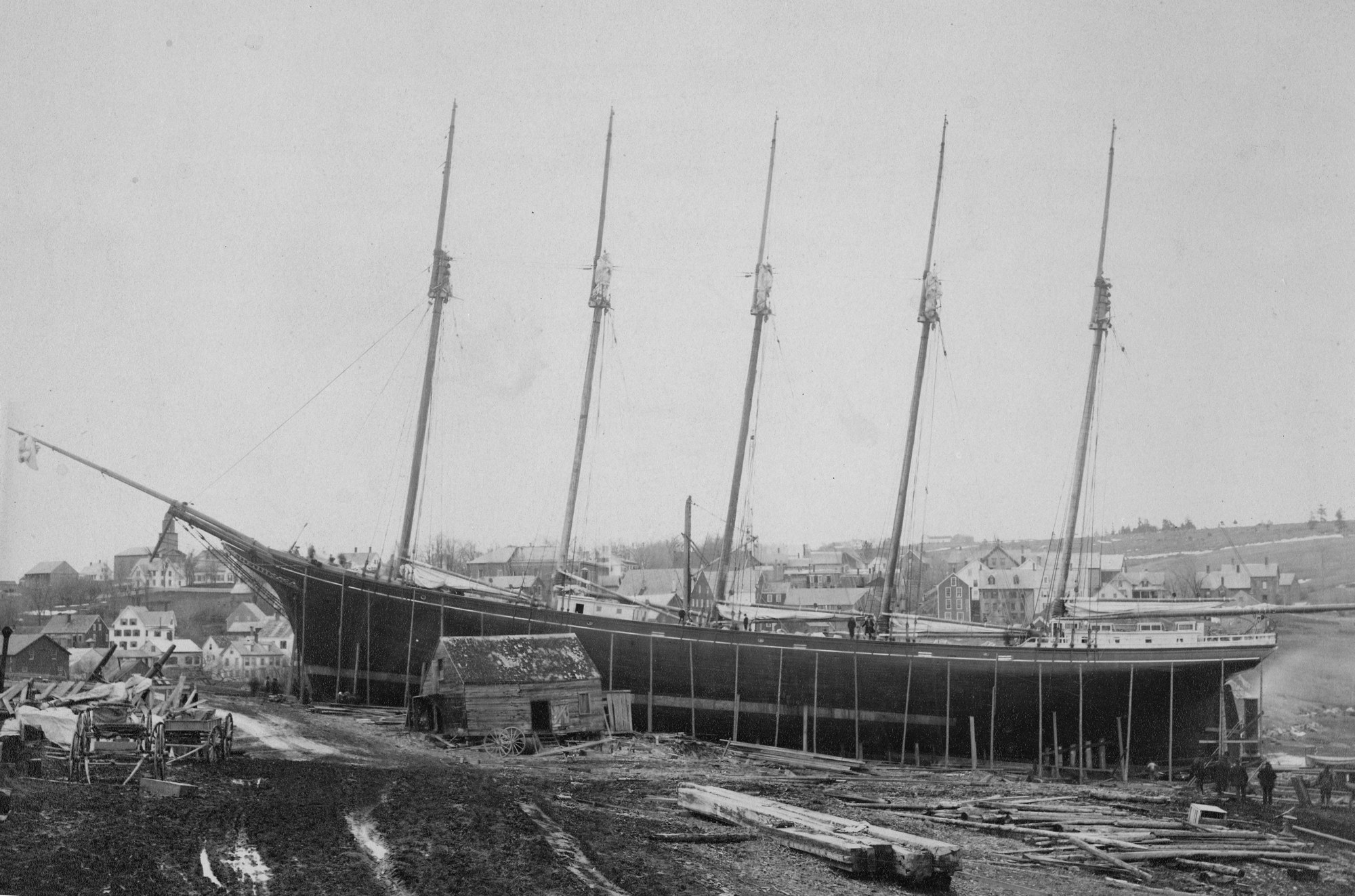
Her final voyage began with a change of command. The original master, Captain William Merritt, fell ill early in the trip and was put ashore at Lewes, Delaware. The company turned to a veteran, Captain Willis B. Wormell, 66 years old, to take over. His first mate was Charles McLellan. On September 8, 1920, the schooner set out with a cargo of coal bound for Rio de Janeiro.
Trouble in Barbados
The ship delivered her coal and left Rio on December 2, 1920, heading north. She stopped at Barbados, and that is where the story starts to darken. According to accounts gathered later by investigators, McLellan got drunk ashore and complained loudly about the captain. He was heard to say:
I’ll get the captain before we get to Norfolk.
First mate Charles McLellan, as reported from Barbados
McLellan was arrested and jailed. Then, oddly, Captain Wormell bailed him out, and the schooner sailed from Barbados around January 9, 1921, bound for Hampton Roads with the same captain and the same mate who had apparently threatened him.
The red-haired man at Cape Lookout
Late in January (sources give January 28 or 29), the schooner passed the Cape Lookout lightship off the North Carolina coast. The keeper, Captain Jacobson, noticed something off. A tall, thin man with reddish hair and a foreign accent, who did not look or act like an officer, called across through a megaphone that they had lost their anchors and asked that the owners be notified. The crew seemed to be milling around on the quarterdeck, a part of the ship where ordinary sailors weren’t usually allowed to gather. Jacobson wanted to pass on the message, but his radio was broken, so he couldn’t report it.
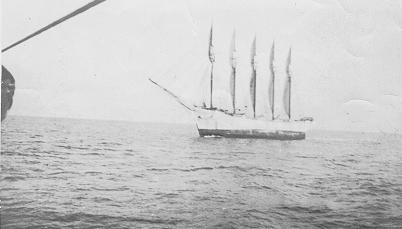
A photograph taken from the lightship is one of the last images of her under sail. Soon after, a steamer came by in the Deering’s wake, and Jacobson tried to hail it to relay the message. The steamer didn’t respond, and he couldn’t make out her name because canvas had been hung over the nameplate. The next day, at about 5:45 in the evening, the steamer SS Lake Elon passed the Deering southwest of the Diamond Shoals lightship and noted that she seemed to be steering a peculiar course. That was the last report of her before Brady spotted the Carroll A. Deering aground.
What the boarding party found
Heavy seas kept the surfboats from reaching the wreck until February 4, 1921, when the wrecking tug Rescue arrived along with the cutter Manning. Captain James Carlson of the Rescue went aboard and confirmed that she was the Carroll A. Deering. The ship was empty. The only living things aboard were three half-starved cats. The ship’s log, navigation instruments, and papers were gone, along with the crew’s personal belongings. Both of her boats were missing, and so were the anchors. In the galley, pots were still on the stove and food was laid out as if for a meal. The wheel and steering gear had been smashed.
There was no sign of what had happened to Captain Wormell, McLellan, or any of the other nine men. None of them was ever found.
The wreck itself was a hazard to shipping, so in March 1921, as she broke apart on the shoals, she was dynamited. A large piece of the stern broke away and drifted, and on March 21 the Coast Guard cutter Seminole found it about 12 miles east of Hatteras and blew it apart with mines.
A message in a bottle
In April 1921, a man named Christopher Columbus Gray of Buxton, on Hatteras Island, reported finding a bottle with a note inside. It read, in part: "DEERING CAPTURED BY OIL BURNING BOAT SOMETHING LIKE CHASER. TAKING OFF EVERYTHING HANDCUFFING CREW…" The note seemed to point to piracy, and handwriting experts argued over it. It didn’t hold up. Federal investigators concluded it was a hoax, and Gray confessed that he had forged it himself.
Five federal departments, no answer
Captain Wormell’s family, along with former master Captain Merritt and a pastor, took the case to Washington, appealing to Senator Frederick Hale of Maine and to Secretary of Commerce Herbert Hoover for a federal investigation. Five government departments looked into it: Commerce, Justice, the Navy, State, and the Treasury. Hoover was concerned that other vessels had also disappeared in the same area around that time, including the sulfur freighter Hewitt. His assistant, Lawrence Richey, was put in charge of the investigation, and in July 1921 an agent of the Bureau of Investigation, the forerunner of the FBI, came to Dare County to follow up leads.
Investigators and newspapers weighed several theories:
Hurricane or bad weather. The National Weather Bureau favored a series of powerful storms in the Atlantic, but the Deering had been sailing away from them at the time.
Piracy. Captain Wormell’s widow believed pirates were to blame, and the mysterious steamer with its name covered fit that idea.
A Bolshevik plot. Newspapers reported the possibility of a Bolshevik plot to seize American ships and their crews and take them to Russia.
Rum-runners. This was the Prohibition era, and one theory held that liquor smugglers took the ship. No evidence for it ever emerged.
Mutiny. Given McLellan’s threat in Barbados and the crew gathered on the quarterdeck at Cape Lookout, Hoover and Richey concluded that mutiny was the most likely explanation, and Senator Hale called it "a plain case of mutiny." Nothing was ever proven.
Not everyone saw a mystery at all. Local Coast Guardsmen thought it impossible that the crew had rowed ashore through that surf, and Captain Ballance of the Cape Hatteras station suspected they had taken everything of value and run the ship onto the shoals on purpose. In late 1922, the investigation was closed without an official finding. The Bermuda Triangle came later: myths about the Triangle didn’t start until some forty years afterward, but the Deering still turns up in those stories today.
Where is the wreck now?
The Carroll A. Deering didn’t stay put after she was dynamited. A piece of her bow drifted down and lodged on Ocracoke Island. In September 1955, Hurricane Ione pushed what was left north from Ocracoke onto the beach of lower Hatteras Island. Today, according to the National Park Service, no remains of the ship can be seen on the seashore’s beaches.
It’s also said that timbers from the wreck washed ashore on Hatteras Island and were used by local residents to build houses. Take that as local telling rather than documented fact. What is better documented is that the Graveyard of the Atlantic Museum in Hatteras village has displayed artifacts from the ship, including her capstan, a running light, a flask, the captain’s desk, and the ship’s bell. If you want to see them, check with the museum before you go, since exhibits change.
So is she haunted?
Honestly? Not in the usual sense. There are no recorded sightings of the crew, no phantom schooner on the shoals, no voices in the surf. The "ghost" of the Ghost Ship of Diamond Shoals is the mystery itself: eleven men, a ship with her sails set and food on the stove, and a century of people trying to work out what happened between Cape Lookout and Cape Hatteras.
Visiting tips
Cape Hatteras Lighthouse. The lighthouse in Buxton overlooks the waters that lead out to Diamond Shoals. It’s part of Cape Hatteras National Seashore; check the NPS site for climbing season and hours.
Graveyard of the Atlantic Museum. In Hatteras village, at the southern end of Hatteras Island. It’s the best place to learn about the shipwrecks of the Outer Banks. Check current hours and exhibits before you visit.
Ocracoke Island. Take the ferry from Hatteras to Ocracoke, where the Deering’s bow once came ashore.
Further reading
The best full-length book on the case is Bland Simpson’s Ghost Ship of Diamond Shoals: The Mystery of the Carroll A. Deering (UNC Press, 2005). The National Park Service, the U.S. Coast Guard, the Hoover Presidential Library, the Library of Congress, and North Carolina Sea Grant’s Coastwatch have all published good short histories online.
FAQ
When was the Carroll A. Deering found?
She was spotted aground on Diamond Shoals, off Cape Hatteras, North Carolina, on January 31, 1921. The Coast Guard boarded her on February 4.
What happened to the crew?
No one knows. All eleven men disappeared, along with both lifeboats, and none of them was ever found.
Is the Carroll A. Deering haunted?
There are no recorded ghost sightings. Her nickname comes from the unsolved disappearance of her crew.
Can you see the wreck today?
No. According to the National Park Service, nothing of the wreck is visible today.
Top image: No high-resolution photograph of the Carroll A. Deering is known. This shows a similar five-masted schooner, the Governor Ames, c. 1895. Photo: Charles Edwin Bolles, public domain, via Wikimedia Commons