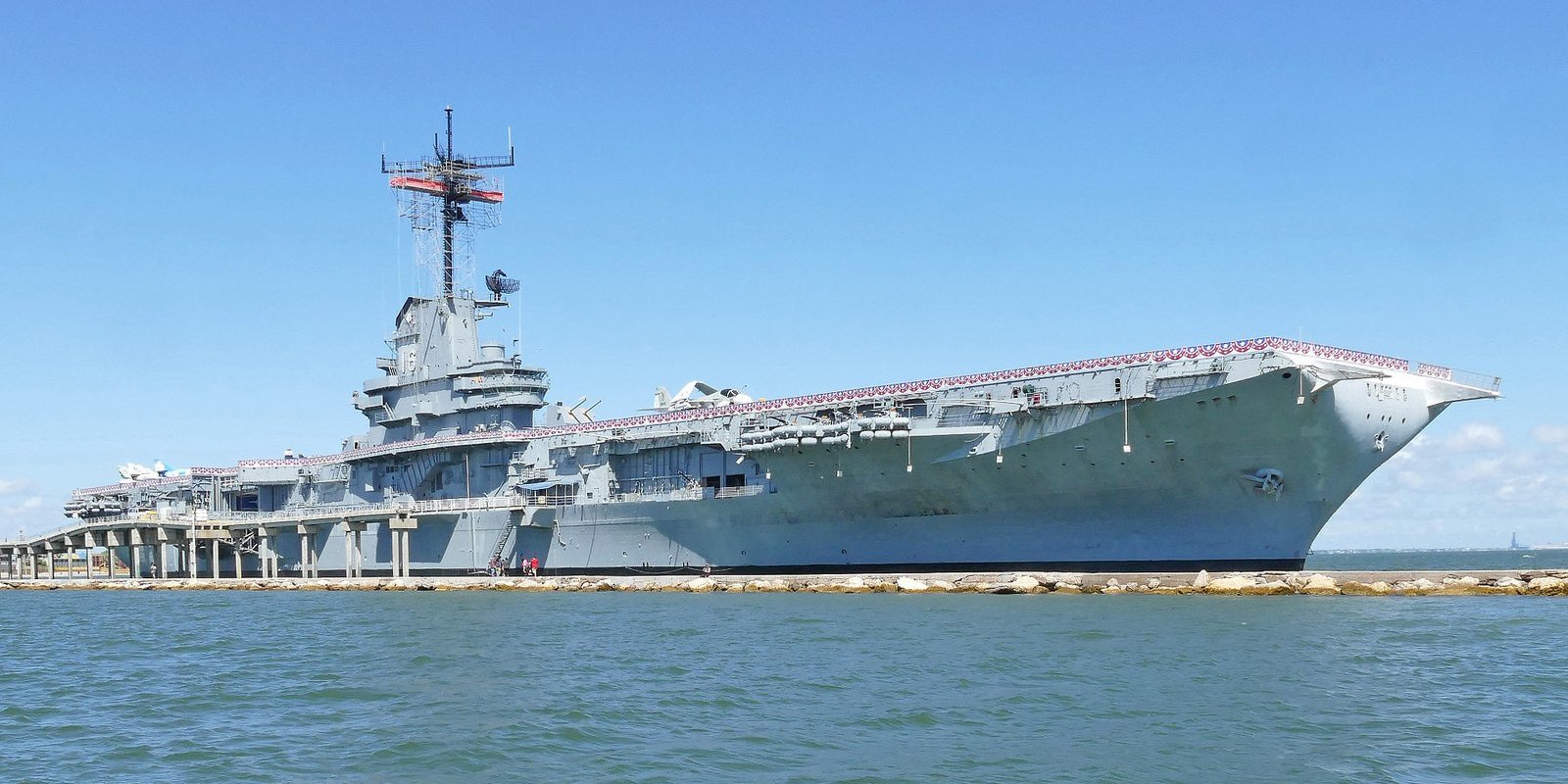
On the waterfront at North Beach in Corpus Christi, an aircraft carrier sits in the shallow water of the bay, her flight deck lined with old Navy planes. She’s the USS Lexington (CV-16), and her nickname is irresistible for a blog like mine: “the Blue Ghost”. The name actually comes from World War II, long before anyone started telling ghost stories about her, but today she has plenty of those too. As always, I’ll tell you the real history first, then the legends, and keep the two separate.
If you’ve read my posts about the USS Alabama in Mobile and the Battleship North Carolina in Wilmington, the Lexington makes a great companion: another WWII museum ship on the Southern coast, but a carrier rather than a battleship, and with a career that lasted until 1991.
A new Lexington
She was laid down in July 1941 at the Fore River Shipyard in Quincy, Massachusetts, as an Essex-class carrier to be named Cabot. In May 1942 the earlier carrier USS Lexington (CV-2), which had been built at the same shipyard, was sunk at the Battle of the Coral Sea. Shipyard workers asked for the new ship to carry the name on, and in June 1942 Cabot became Lexington. She was launched in September 1942 and commissioned on 17 February 1943. Although her surviving Essex-class sisters Yorktown, Intrepid and Hornet have lower hull numbers, Lexington was commissioned earlier, which makes her the oldest surviving fleet carrier in the world.
The Blue Ghost
Lexington went to the Pacific in 1943 and fought across it for the rest of the war, often as flagship for Admiral Marc Mitscher’s fast carrier task force. Her aircraft fought at the Gilberts and Marshalls, Truk, the Battle of the Philippine Sea, Leyte Gulf, Iwo Jima and Okinawa, and struck the Japanese home islands.
On the night of 4 December 1943, off Kwajalein, a Japanese torpedo hit her starboard side and knocked out her steering. Nine men were killed. Japanese propaganda, including the radio broadcasts Americans called “Tokyo Rose”, announced that she had been sunk. It was the first of several such claims. Each time, Lexington turned up again, and because she was painted in a dark-blue scheme rather than the dazzle camouflage worn by many other carriers, she became known as “the Blue Ghost”.
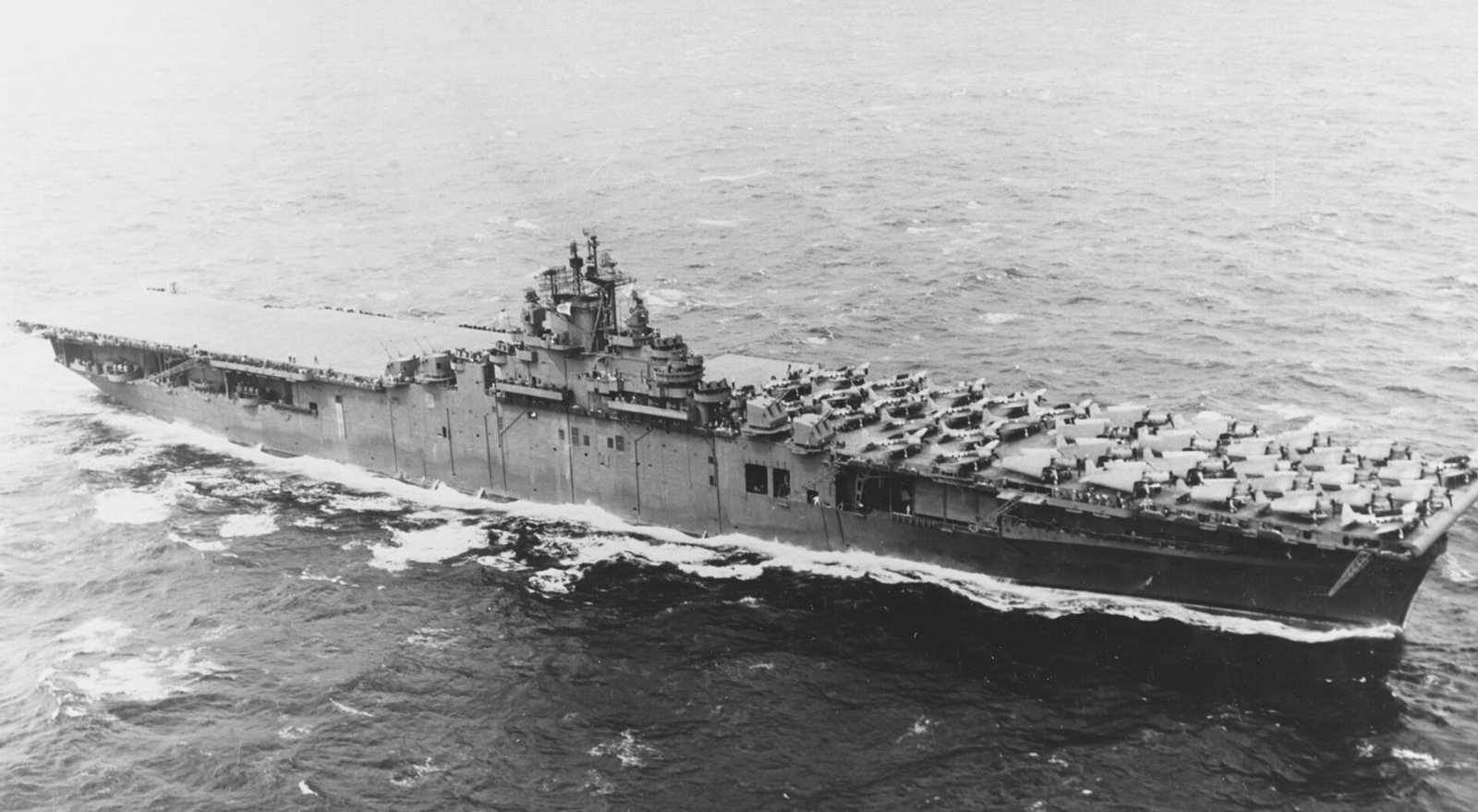
Her worst day came on 5 November 1944, off Luzon. A burning Japanese kamikaze plane crashed near her island, wrecking much of the island structure and spraying fire across the deck. The crew had the fires under control within about 20 minutes and kept flying, but 50 men were killed and 132 wounded. Within days Tokyo was claiming her sunk again. She finished the war with 11 battle stars and a Presidential Unit Citation.
Training carrier for a generation of pilots
After the war Lexington was laid up, then rebuilt in the early 1950s with an angled deck and a closed “hurricane” bow so she could operate jets. She served as an attack carrier and anti-submarine carrier in the Pacific and elsewhere. In late 1962, after a stint on alert during the Cuban Missile Crisis, she became the Navy’s training carrier in the Gulf of Mexico, based at Pensacola, Florida. For almost 30 years, thousands of student naval aviators made their first carrier landings on her deck. In 1980 she became the first U.S. carrier to have women assigned as crew.
She was finally decommissioned on 8 November 1991, the last Essex-class carrier in service and the one with the longest active career of any of them.
The museum on the bay
The Navy turned her over to Corpus Christi in late 1991, and on 15 June 1992 she opened as the USS Lexington Museum on the Bay. Today she has restored aircraft on her flight deck and hangar deck, exhibits, simulators and a giant-screen theater built into the space of a former aircraft elevator. She was named a National Historic Landmark in 2003.
The ghost stories
Now for the legends. These come from museum staff, volunteers, visitors and paranormal investigators, not from historical records. The museum itself is quite open about them, and even hosts ghost hunts.
Charlie, the engine-room guide
The most famous story is of “Charlie”, a polite young sailor with blond hair and striking blue eyes. Visitors exploring the engine room say a sailor explained to them in detail how the turbines worked and then vanished. When they later thank the staff for such a knowledgeable guide, they’re told that no guide was on duty there. One version claims that a photo of a sailor killed in the 1943 torpedo attack was shown to visitors, who recognized him. However, the Navy’s account of that attack places the deaths on the fantail and in the chief petty officers’ mess, not the engine room, and I couldn’t find any record of who Charlie might be.
Other sightings
Museum staff have told the local newspaper that they get many reports of strange activity every year: a uniformed sailor helping lost visitors find their way back to the deck, shadowy figures, footsteps, voices, touches, and things that vanish and reappear. One longtime staff member described losing six pen caps over several weeks and finding them all lined up by his keyboard one morning. Security staff have reported running footsteps in the hangar bay in the middle of the night. Some volunteers connect these stories to the torpedo and kamikaze attacks.
Investigations and TV
The ship has been visited by many paranormal investigators and featured on paranormal TV programs over the years. I’ve seen Ghost Lab on Discovery mentioned, but I haven’t confirmed the details. The stories are told with good humor at the museum, and staff say the ghosts have never been menacing.
Ghost tours and overnights
The museum has offered evening paranormal tours for adults, private overnight investigations for small groups, and a public “Blue Ghost Paranormal Overnight Investigation”. The 2026 edition ran on 10–11 April, with a tour of six “hot spots”, a night in the crew’s berthing and breakfast in the mess. The museum also runs overnight camping programs for youth groups. Dates, prices and age limits change, so check the museum’s events page.
Visiting the Lexington
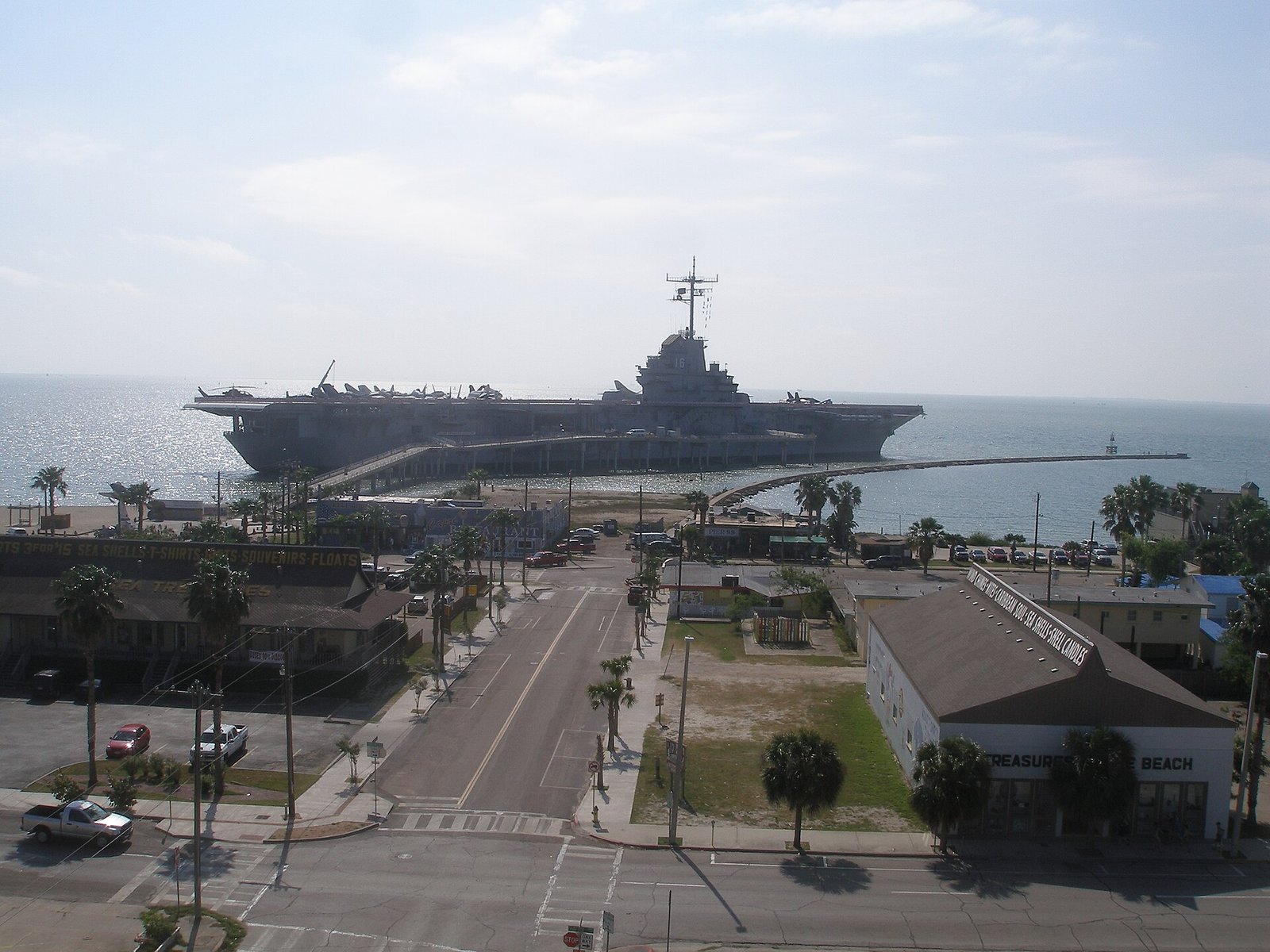
The museum is at 2914 North Shoreline Boulevard in Corpus Christi, on North Beach, near the Texas State Aquarium. There are several self-guided tour routes, from the flight deck and island to the hangar deck, sick bay, engine room and berthing. Some routes involve steep ladders and narrow passageways, so wear sensible shoes.
The museum’s website recently listed hours of 9 a.m. to 5 p.m. for most of the year, and until 6 p.m. in summer (Memorial Day to Labor Day). Adult admission has been in the mid-twenties of dollars, with discounts for children, seniors and military, and there is a parking fee. Check usslexington.com before you go, as hours, prices and closures change.
My take
Whether or not Charlie still explains the turbines to visitors, the Blue Ghost earned her name by coming back again and again when the enemy said she was gone. That’s the kind of ghost I like best.
FAQ
Why is the USS Lexington called the Blue Ghost?
During WWII, Japanese propaganda claimed several times that she had been sunk, but she kept reappearing. Her dark-blue paint scheme completed the nickname.
Who is Charlie on the USS Lexington?
Charlie is the name staff gave to a ghostly young blond sailor who visitors say explains the engine room to them and then disappears. There is no historical record of who he might be.
Can you stay overnight on the USS Lexington?
The museum has offered paranormal overnight investigations and youth-group overnight programs. Check the museum’s website for current dates.
Was the Lexington ever sunk?
No. She was hit by a torpedo in December 1943 and by a kamikaze in November 1944, but she survived both and served until 1991.
Top image: USS Lexington, the Blue Ghost, at Corpus Christi. Photo: Jim Evans, CC BY-SA 4.0, via Wikimedia Commons