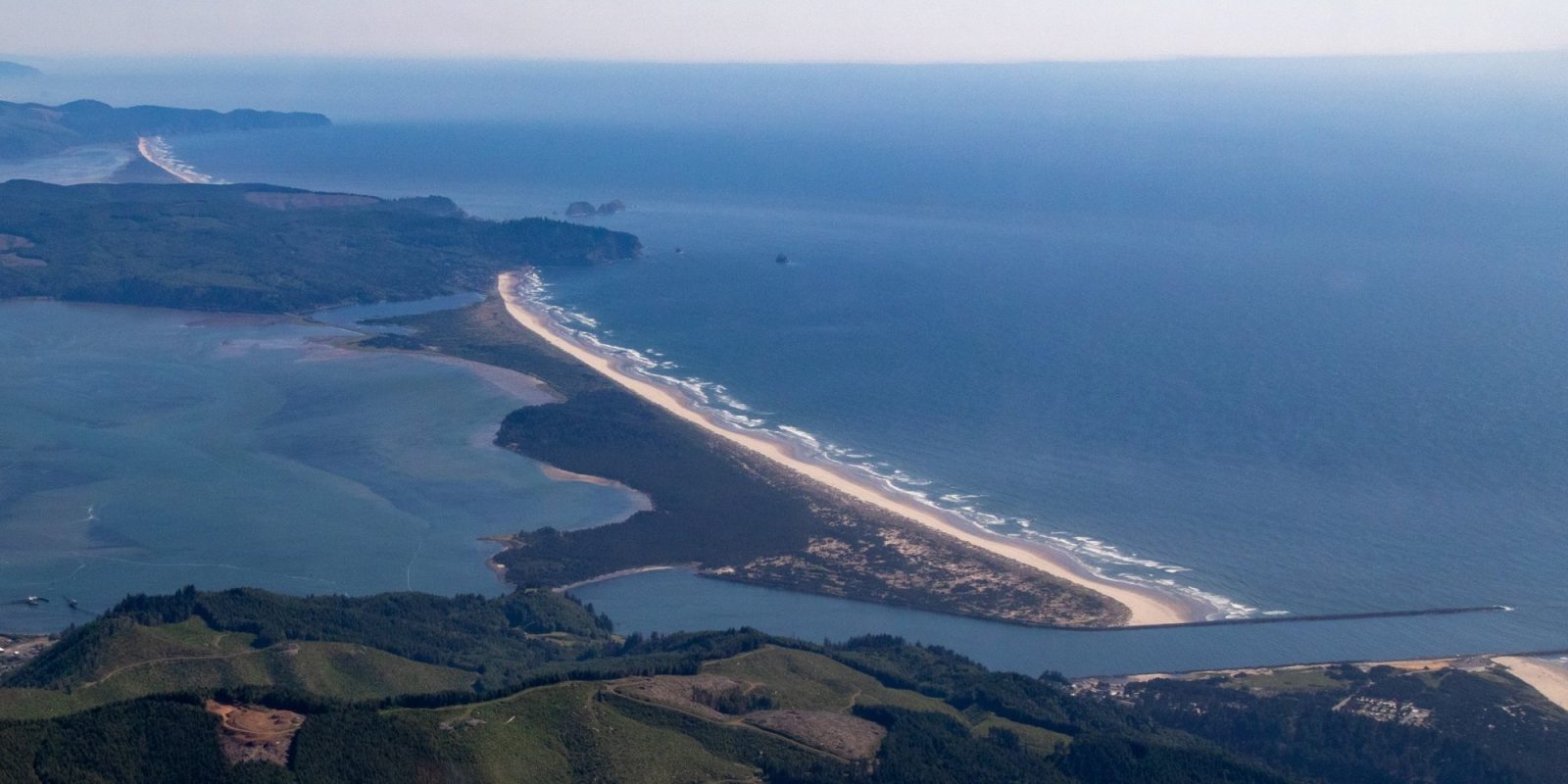
I went looking for a phantom ship said to haunt the Tillamook Spit, the long finger of sand that closes off Tillamook Bay on the north Oregon coast. The spit does turn up in ghost-lore books. It is listed in Dennis William Hauck’s Haunted Places: The National Directory, under Tillamook. But when I went looking for the story behind that listing, I hit a wall. I couldn’t find a single detailed account of a ghost ship seen off the spit: no witness, no date, no name for the ship. What I found instead was a whole town that the sea swallowed, a yacht that came and went, and, about 50 miles up the coast, a real wreck that gave Oregon one of its best ghost-ship stories.
So this is a slightly different kind of post. It’s about a ghost ship that, as far as I can tell, has never been properly documented, and the real phantoms that crowd the coast around it.
The spit and the town that fell into the sea
Tillamook Spit, now usually called Bayocean Spit or the Bayocean Peninsula, is a sand dune peninsula between the Pacific Ocean and Tillamook Bay. According to the Oregon Encyclopedia, it was about four miles long and half a mile wide, with a tree-covered knoll 140 feet high.
In 1906, the Portland real estate promoters Thomas Benton Potter and his son Thomas Irving Potter started building a resort there. They promised it would be the "Queen of Oregon Resorts" and "the playground of millionaires," and it came to be called "the Atlantic City of the West." The first lots sold in 1907, and by 1914 more than 600 had been sold. Visitors found paved and lighted streets, a post office, a school, a bakery, a three-story hotel, and a 160-foot heated saltwater natatorium with a wave machine, a dance pavilion, and a 1,000-seat theater.
Then the sea went to work. A north jetty built at the mouth of Tillamook Bay in 1914 to 1917 changed the wave patterns along the spit, and erosion began eating the beach. The natatorium closed in 1932. An extension of the jetty in 1933 made things worse, and eventually the spit was breached, turning Bayocean into an island. The post office closed in 1953. On February 15, 1960, the last house went into the ocean. Today the town site is mostly under water, and Tillamook County manages the spit as a park.
If any place on this coast deserves a ghost, it’s Bayocean. But the haunting people talk about here is the town itself, not a ship.
The yacht Bayocean
The spit did have one famous ship. With no good roads between Portland and the coast, the Potters built a motor passenger vessel called the Bayocean, described by the Oregon Encyclopedia as the largest yacht on the Pacific Coast. She could bring up to 100 well-off prospects to see the lots.
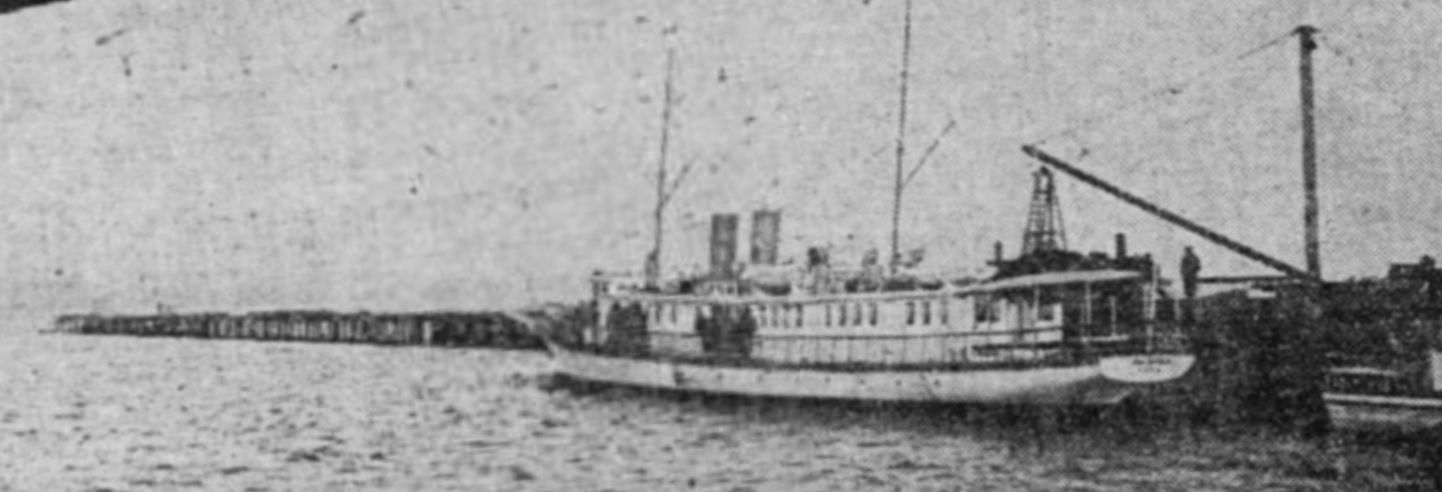
According to the Bayocean history site bayocean.net, the yacht was commissioned in the spring of 1911 and cut the trip from two days to about twelve hours. But crossing the rough bars at the Columbia River and Tillamook Bay was miserable for most passengers, and she had frequent mechanical trouble. Once a railroad between Portland and Tillamook was finished that November, she was sold. Photographs on Wikimedia Commons show her later in U.S. Navy service during World War I. Her eventual fate is poorly documented.
No source I found describes the Bayocean returning as a phantom. If the spit’s ghost ship is a memory of her, nobody seems to have written that down.
The real phantom of the coast: the Lupatia and Terrible Tilly
For a ghost ship with an actual story behind it, you have to head north. Tillamook Rock sits about 1.2 miles off Tillamook Head, between Seaside and Cannon Beach, roughly 50 miles north of Tillamook Bay. The rock shares the Tillamook name, but it’s in Clatsop County, not on the spit. The Oregon Encyclopedia describes it as a basalt island less than an acre in size, rising nearly 100 feet from the sea.
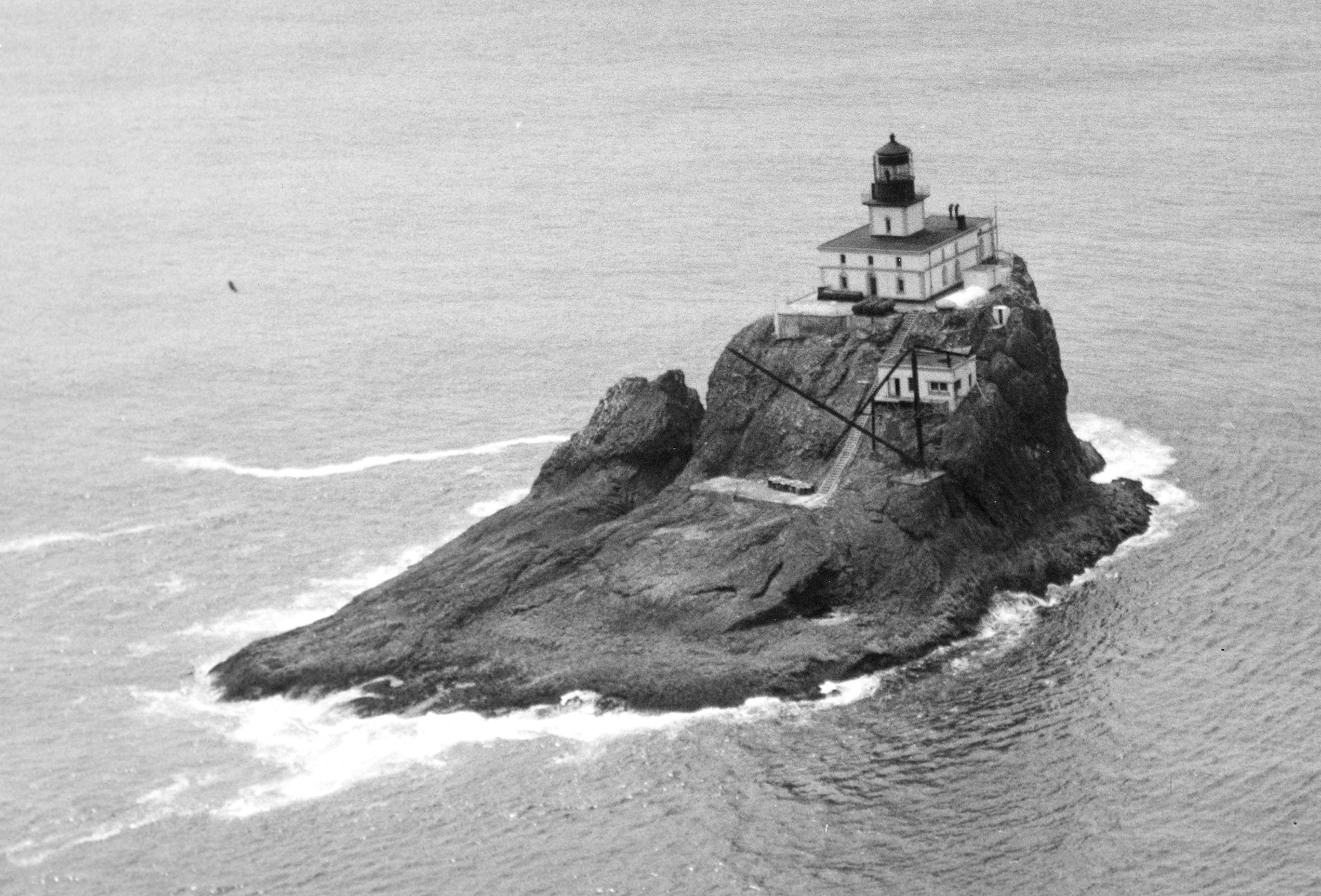
Building a lighthouse there was brutal. The first surveyor, master mason John R. Trewavas, lost his footing on the rock and was swept into the sea. Local workers were reluctant to go out, so the foreman hired quarrymen from outside the area. One gale marooned the crew for sixteen days.
In early January 1881, with the light just weeks from being lit, the British barque Lupatia came in through thick weather and a strong gale. The Cannon Beach History Center quotes Lewis and Dryden’s Marine History of the Pacific Northwest: the construction crew "sighted the red light of a ship inshore, and heard a terror-stricken voice give the order, ‘Hard aport.’" Superintendent Wheeler had lanterns put in the unfinished tower and a bonfire built to warn the ship. For a moment she seemed to be working clear. Then the red light disappeared, and there were no more cries.
All 16 of the Lupatia‘s crew were lost. The only survivor was the ship’s dog, found on the beach among the dead. Tillamook Rock Light was lit on January 21, 1881, too late for her.
What the keepers said they saw
Tillamook Rock Light ran until 1957, and over those decades it picked up the nickname Terrible Tilly, along with a long list of ghost stories. ClatsopNews, drawing on Mike Helm’s 1983 book Oregon’s Ghosts & Monsters, reports that James A. Gibbs, who served a year on the rock and later wrote about it, insisted the place was haunted, and that all four keepers on shift one night saw a ghost ship. Gibbs also described hearing "a whispering moan, like one in pain." Many retellings link that phantom to the Lupatia, and some people on the coast say a dog can still be heard howling out at the tip of Tillamook Head.
Treat all of that as folklore. It comes from keepers’ memories passed through popular ghost books, not from a log entry. Oregon Coast Beach Connection makes the same point, noting that ghost-ship stories at Tilly "usually have foundations in actual events involving near misses from real ships." Even so, this is the strongest ghost-ship legend anywhere on the Tillamook-named coast, and I wouldn’t be surprised if it’s the story that drifted south and attached itself to the spit.
The Beeswax Wreck: a real mystery ship
Between Tilly and the spit sits one more ship that haunted this coast for centuries, though not as a ghost. Since the earliest days of white settlement, people told stories about a mystery wreck on Nehalem Spit, where the Nehalem River meets the Pacific, leaving behind Chinese porcelain and big blocks of beeswax.
The Oregon Encyclopedia says the wreck was first written about in 1813 by the fur trader Alexander Henry of Astoria, after Clatsop people brought wax to trade and said it came from a large ship wrecked long before at Nehalem. Over the years it was blamed on a Spanish galleon, a Chinese junk, a Portuguese trader, or a pirate. Settlers collected tons of wax and made furniture from the teak timbers, and treasure hunters dug on nearby Neahkahnie Mountain looking for buried loot.
Archaeologists working on the Beeswax Wreck Project now identify her as the Manila galleon Santo Cristo de Burgos, which left Manila in 1693 with Chinese goods and wax, carrying 220 crew and sixteen passengers, and was never seen again. The Oregon Encyclopedia states the identification firmly. Its companion article says "most likely," and estimates the wreck happened between November 1693 and February 1694. Whether anyone survived is unknown.
So is there a ghost ship off Tillamook Spit?
Honestly, I don’t know. The spit is listed as haunted in Hauck’s directory, but I couldn’t find any detailed sighting to back it up, and I’m not going to invent one. What the spit offers is a ghost town, not a ghost ship. The coast’s real phantom ship belongs to Tillamook Rock, about 50 miles north. If you’ve heard a firsthand story of a ship appearing off Bayocean, I’d genuinely love to hear it.
Visiting
Bayocean Spit. The Oregon Hikers field guide describes a 7.8-mile loop with almost no elevation gain, out along the beach to the South Jetty and back on an old road on the bay side, with a short interpretive trail to the old townsite. Watch for snowy plovers, which are protected.
Cape Meares. Just south of the spit, Cape Meares State Scenic Viewpoint has a paved 0.2-mile path to Oregon’s shortest lighthouse, first lit in 1890. Oregon State Parks says the lighthouse is open 11 a.m. to 4 p.m. from Memorial Day through September 30, while the grounds stay open year-round. The U.S. Fish & Wildlife Service says to come in through Netarts, not Bayocean Road, because part of the loop road has been closed by landslides.
Terrible Tilly. The lighthouse is privately owned and closed to the public, but you can see it from Seaside, Cannon Beach, and Ecola State Park. The shortest hike to the Tillamook Head viewpoints is about 1.3 miles from the Indian Beach trailhead.
Quick facts
Where is Tillamook Spit?
It’s the Bayocean Peninsula, the sand spit between Tillamook Bay and the Pacific, west of Tillamook, Oregon.
Is there a documented ghost ship there?
Not one I could find. The spit is listed in Hauck’s Haunted Places, but I found no detailed published sighting.
What is Terrible Tilly’s ghost ship?
Keepers’ folklore, often linked to the barque Lupatia, which was wrecked near Tillamook Rock in January 1881 with the loss of all 16 crew.
Sources: Oregon Encyclopedia articles on Bayocean, Tillamook Rock Lighthouse, and the Beeswax shipwreck; bayocean.net; Cannon Beach History Center; ClatsopNews; Oregon Coast Beach Connection; Oregon Hikers; Oregon State Parks.
Top image: The Bayocean Peninsula (Tillamook Spit) seen from the air, 2022. Photo: Tedder, CC BY-SA 4.0, via Wikimedia Commons