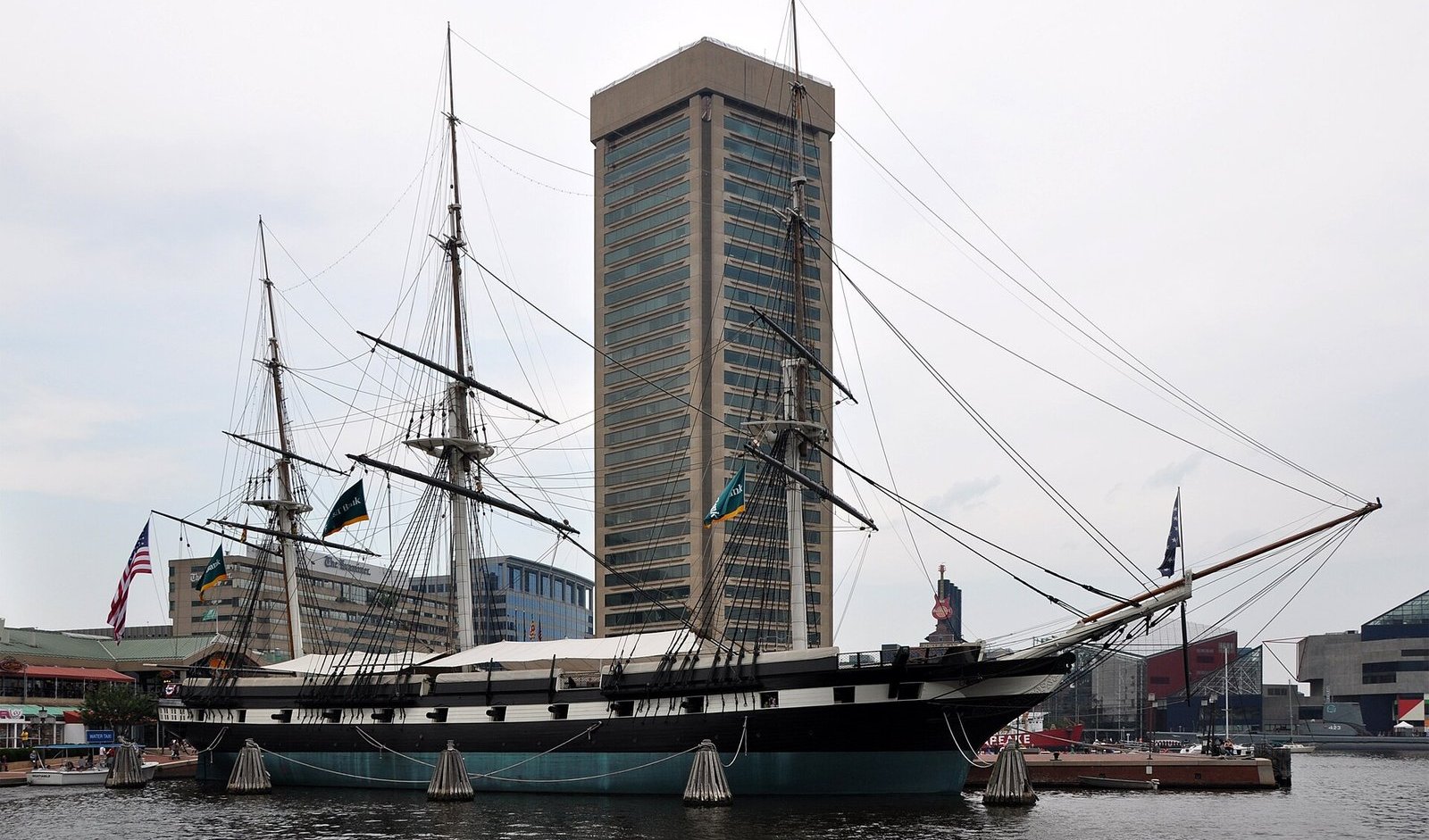
Walk along the brick promenade of Baltimore’s Inner Harbor and, among the glass towers and the paddle boats, you’ll find something that looks as if it sailed straight out of another century: a tall, black-hulled wooden warship with three masts and a white stripe of gunports. This is the USS Constellation, and she is one of my favourite ships anywhere. People sometimes call her “the Constitution” by mistake, or think she’s Old Ironsides, but that ship is up in Boston. The Constellation is her own vessel with her own remarkable story, and, so they say, her own ghosts. As always, I’ll tell you the history first and the legends after, and keep the two apart.
The last sail-only warship of the U.S. Navy
The Constellation you see today is a sloop-of-war, built at the Gosport Navy Yard in Norfolk, Virginia. Her keel was laid in June 1853 and she was launched on 26 August 1854. She was designed by the Navy’s chief constructor John Lenthall and built mostly from a stockpile of live oak that the Navy had been saving for decades. She was the last warship the U.S. Navy designed and built to rely on sails alone, with no steam engine, and she carried a powerful battery of 8-inch shell guns. Her crew was around 285 officers and men.
She was commissioned in July 1855 and spent her first three years with the Mediterranean Squadron, protecting American citizens and shipping.
Hunting slave ships off Africa
The part of her career I find most moving came next. In 1859 she became flagship of the Navy’s Africa Squadron, patrolling the West African coast to stop the illegal Atlantic slave trade. In December 1859 she captured the brig Delicia, fitted out to carry enslaved people. On 26 September 1860 she captured the barque Cora with 705 captive Africans aboard, who were freed and landed at Monrovia, Liberia. In May 1861, just after the Civil War began, she captured yet another slaver. Few ships anywhere can say they set hundreds of people free.
Civil War and the long years of training
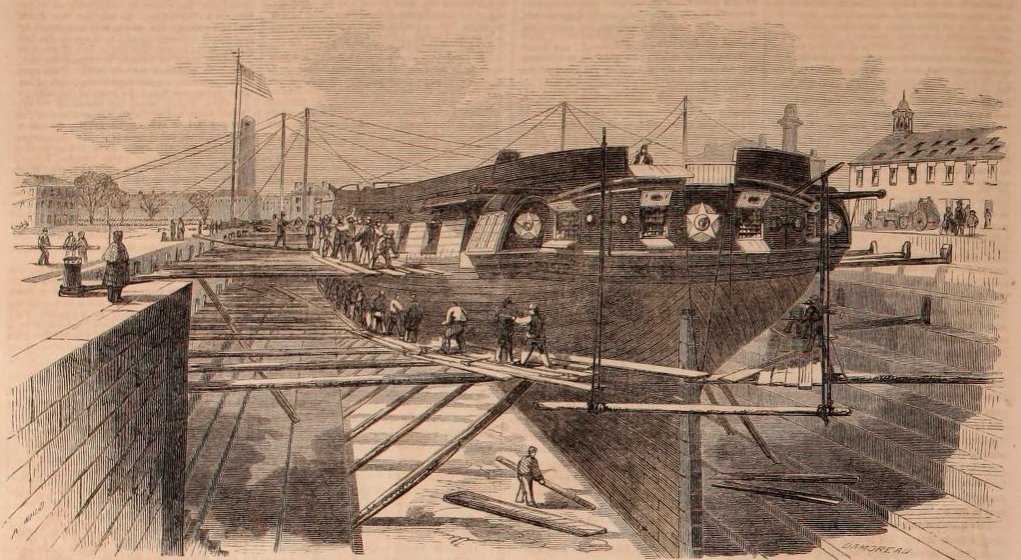
During the Civil War, Constellation was sent to the Mediterranean in 1862 to protect Union merchant ships from Confederate raiders. Her sails gave her far more endurance than a coal-hungry steamer. She saw little fighting, though she helped keep the Confederate raider CSS Sumter bottled up at Gibraltar. She came home in late 1864 and spent the rest of the war as a receiving ship. Today she is the last surviving intact naval vessel that served in the Civil War.
From 1871 she spent more than twenty years as a training ship for midshipmen from the Naval Academy. She also had some unusual jobs: carrying American exhibits to the 1878 Paris Exposition, and in 1880 carrying more than 2,500 barrels of food to Ireland for famine relief. From 1894 she was a stationary training ship at Newport, Rhode Island, and she was even recommissioned in 1940, serving as a reserve flagship for the Atlantic Fleet during World War II. She was finally decommissioned in February 1955 and towed to Baltimore.
Is she the 1797 frigate? The great identity debate
Here’s where things get tangled. The Navy’s first Constellation was a famous 38-gun frigate launched in Baltimore in 1797, commanded by Captain Thomas Truxtun, who won two famous battles against French frigates in 1799 and 1800. That old frigate was broken up at Norfolk in 1853, just as the new sloop was being built nearby, and the Navy’s paperwork treated the new ship as a “rebuild” of the old one.
For much of the twentieth century, many people believed the Baltimore ship really was the 1797 frigate, and she was even altered in the 1950s and 1960s to look more like it. Naval historian Howard Chapelle argued as early as 1949 that the hull dimensions proved she was a different ship, and the argument went on for decades, made worse by forged documents produced to support the frigate claim. In 1991 a detailed Navy-sponsored study by researcher Dana Wegner concluded that she is the 1854 sloop, and that is now the accepted view. A few timbers from the old frigate may have been reused, but she is a new ship.
Restorations and the museum
By the 1990s she was in terrible shape, with dry rot and a keel that had sagged about three feet. In 1996 she was moved to a dry dock, and a roughly $7 million restoration finished in 1999 returned her to her 1854 appearance and replaced about half her timbers. In 2004, for her 150th birthday, she was towed to Annapolis, her first trip out of Baltimore since 1955. More hull repairs followed at the Coast Guard Yard in 2014–15, and maintenance continues.
Today she is the flagship of Historic Ships in Baltimore, a museum that also includes the World War II submarine USS Torsk, the Coast Guard cutter Taney (the last warship afloat that was at Pearl Harbor), the lightship Chesapeake and the Seven Foot Knoll Lighthouse.
The ghost stories
Now for the legends. What follows comes from visitors, staff, ghost-story books and paranormal investigators, not from historical records. Notice that many of the stories really belong to the 1797 frigate, which is part of the fun.
Neil Harvey
The best-known story tells of a seaman named Neil Harvey who, during the frigate’s 1799 battle with the French frigate L’Insurgente, was said to have fallen asleep on watch or deserted his gun. In the legend Captain Truxtun had him run through with a sword and his body blown from a cannon. Historians say a sailor really was killed by one of the frigate’s officers during that battle for leaving his post, but the cannon part looks like later embroidery. Visitors have reported a man in old-fashioned clothes on the decks, sometimes mistaken for a costumed guide.
Thomas Brown, the “powder monkey”
Powder monkeys were boys who ran gunpowder up to the guns during battle. The legend of Thomas Brown, a young powder monkey said to have died aboard, is told in some ghost books, but I couldn’t find him in any historical record. People say they’ve heard a child’s footsteps running on the gun deck and felt something brush past them.
Captain Truxtun
Captain Thomas Truxtun himself is said to walk the quarterdeck, sometimes announced by a smell of gunpowder. Of course, Truxtun commanded the old frigate and died in 1822, decades before this ship was built.
The 1955 photograph
The most famous piece of “evidence” is a photo taken just before midnight in late December 1955 by Lieutenant Commander Allen Ross Brougham of the Naval Reserve. Published in the Baltimore Sun on 31 December 1955, it shows a blurred, glowing figure in what looks like an officer’s uniform with epaulets and a sword. Brougham said he smelled gunpowder just before it appeared. Some people think it shows Truxtun; others point out that the uniform looks more like the 1850s; and skeptics suspect a double exposure or a hoax.
On television
The ship has been featured on paranormal TV shows and investigated by ghost-hunting groups over the years, and the stories are a regular part of Baltimore ghost tours. Historic Ships in Baltimore has held special evening and Halloween events at times; check what’s on before you go.
Visiting the Constellation
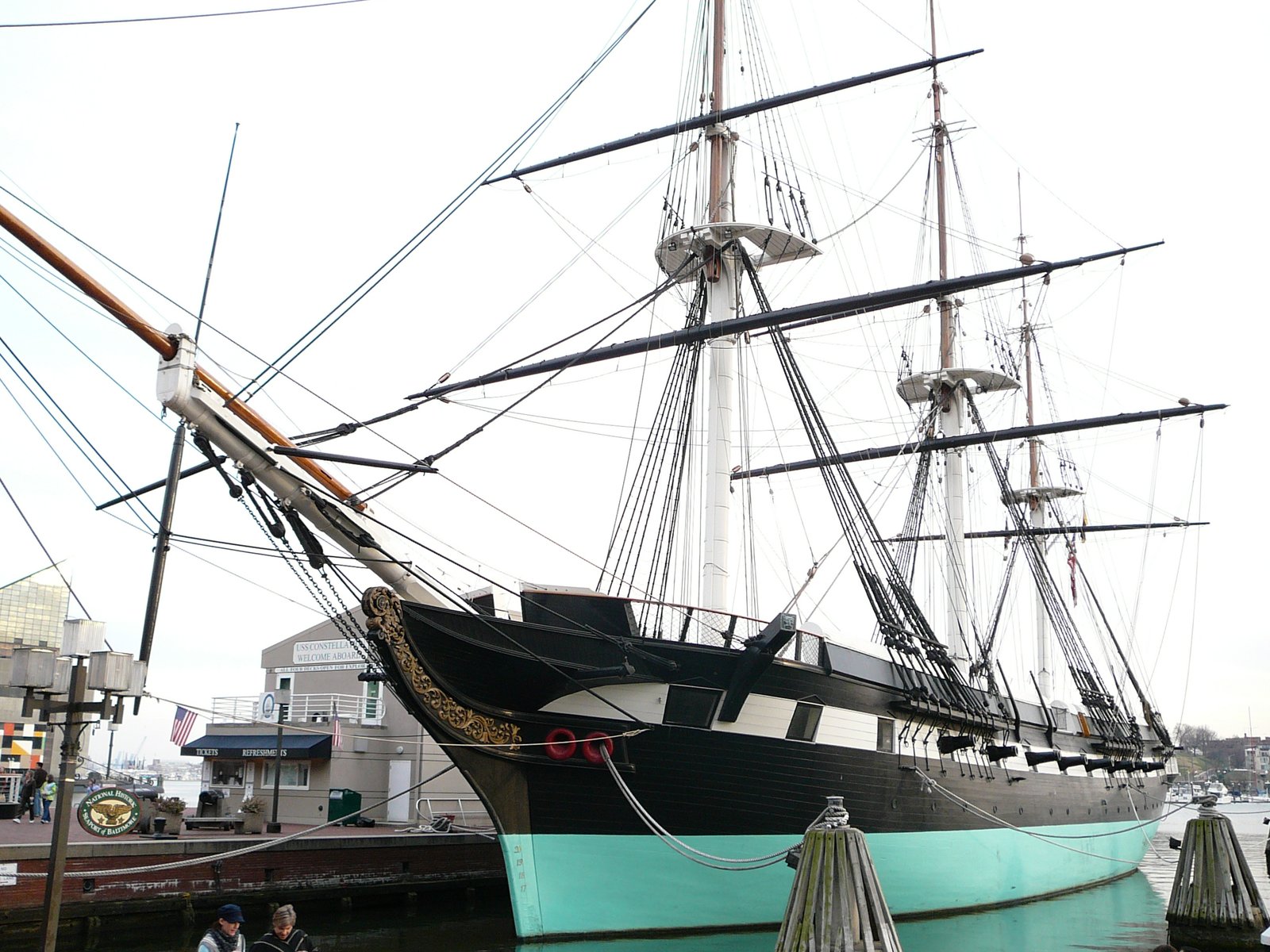
The ship is moored at Pier 1, 301 East Pratt Street, in Baltimore’s Inner Harbor, a short walk from the National Aquarium. You can explore the spar deck, the gun deck with its big cannon, and the berth deck below. There are sometimes cannon-firing and other living-history demonstrations. The ladders are steep and the lower decks low, so mind your head.
As a rough guide, the ships have typically been open from about 10 a.m. to 4:30 or 5 p.m., with shorter hours or closed days in winter. One ticket usually covers several or all of the museum’s ships, and adult prices have recently been in the high teens to around twenty dollars, with discounts for children, seniors and military. Hours and prices change, so check historicships.org before you visit. Inner Harbor parking garages are nearby, but they can be pricey.
My take
Whether or not Neil Harvey still walks her decks, the Constellation is a genuine survivor. She freed hundreds of captives, fed the hungry in Ireland, trained generations of sailors, and outlived a century of arguments about who she really is. Even without ghosts she’d be worth the trip.
FAQ
Is the USS Constellation the same ship as the USS Constitution?
No. The USS Constitution (“Old Ironsides”) is the 1797 frigate in Boston. The USS Constellation in Baltimore is an 1854 sloop-of-war. People mix them up because the names are so similar.
Is the Baltimore Constellation the original 1797 frigate?
No. After decades of debate, research published in 1991 showed she is a new ship built in 1853–54, not the frigate rebuilt.
Is the USS Constellation haunted?
There’s no proof, but visitors and investigators have reported apparitions, footsteps and the smell of gunpowder, and a famous 1955 photo is said to show a ghostly officer.
What else can you see at Historic Ships in Baltimore?
The submarine USS Torsk, the Coast Guard cutter Taney, the lightship Chesapeake and the Seven Foot Knoll Lighthouse.
Top image: USS Constellation at Baltimore’s Inner Harbor. Photo: Joe Ravi, CC BY-SA 3.0, via Wikimedia Commons