Most ghost ships on the Great Lakes come with a date, a name, and a list of the crew. Le Griffon comes with almost none of that. She was the first European-style sailing ship built on the upper Great Lakes, and in September 1679, on her very first voyage, she sailed away from an island near the mouth of Green Bay and was never seen again. Nobody knows where she went down, or even for sure that she went down at all.
That makes her the first ship lost on the upper Great Lakes. It also makes her a perfect blank space for a ghost story, and about two hundred years later, someone wrote one. This post is about both: what the record actually says, and where the curse and the phantom ship came from.
A ship built above the falls
The ship belonged to René-Robert Cavelier, Sieur de La Salle, the French explorer who wanted to push a fur-trading empire west and south through the interior of North America. Canoes couldn’t carry the cargo he had in mind, so he decided to build a real sailing vessel above Niagara Falls, where nothing could stop her from reaching the upper lakes.
According to the accounts of the Recollect friar Louis Hennepin, who was there, the keel was laid on January 26, 1679, near the mouth of Cayuga Creek on the upper Niagara River. The builders worked through the winter, and the ship was launched that spring, earlier than planned. Hennepin says they were afraid the Seneca, who were unhappy with the French presence, would burn her on the stocks.
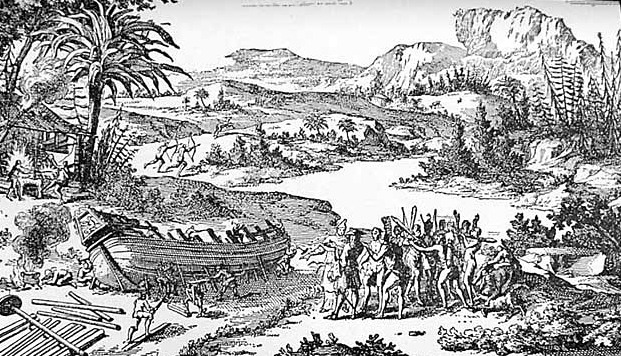
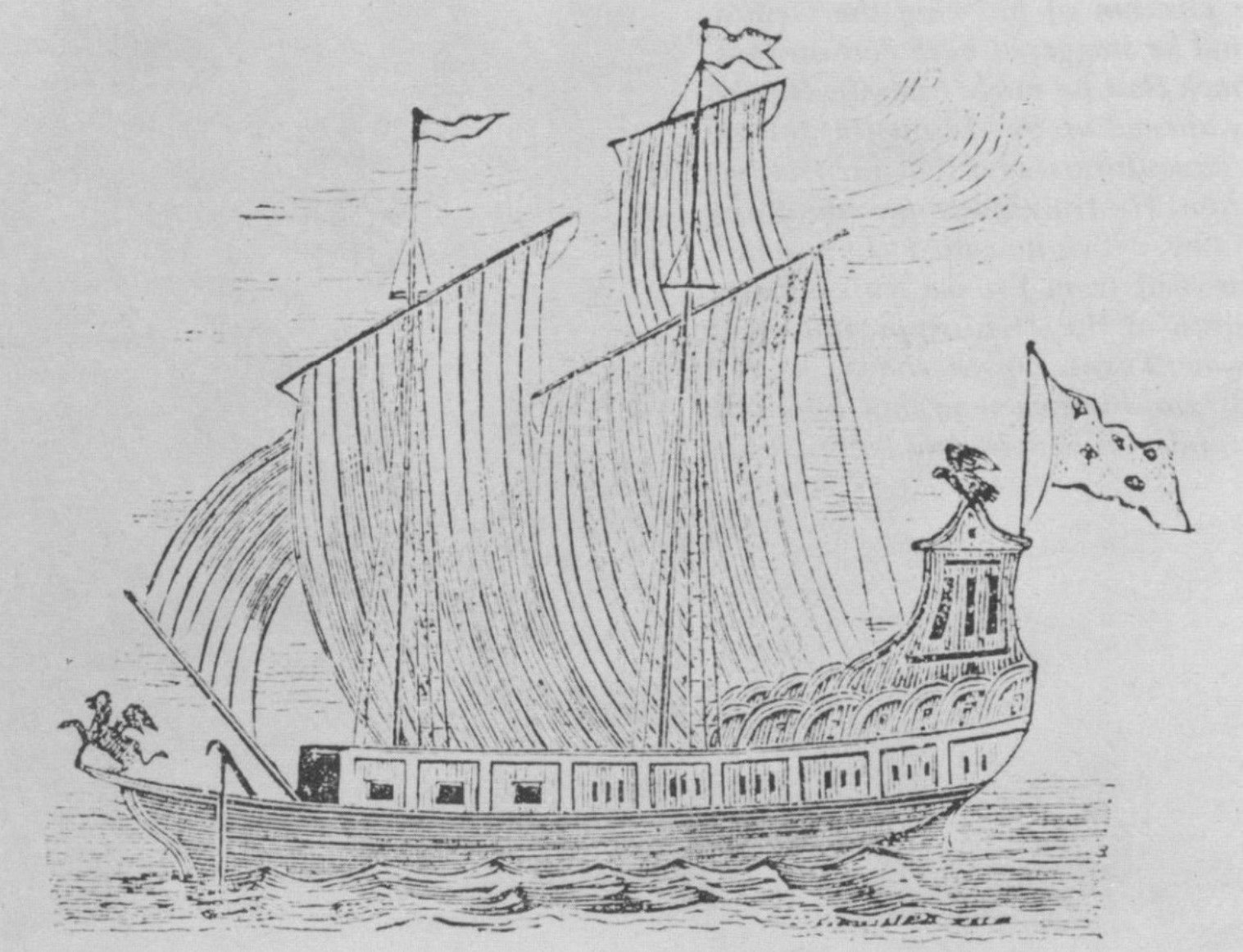
Her name is often said to honor the griffins on the coat of arms of Frontenac, the governor of New France who backed La Salle, though that’s repeated more than documented. Hennepin’s first account puts her at about 45 tons; a later edition says 60, which is a good early warning that even the basic facts about this ship wobble depending on the source. She carried seven small cannon.
The first voyage
Le Griffon set sail on August 7, 1679, with La Salle, Hennepin, and a crew usually given as about 32 to 34 men. She crossed Lake Erie in a few days. On August 12 the party reached the small lake between Erie and Huron, and because it was the feast day of St. Clare, Hennepin says, they named it Lac Sainte-Claire.
Lake Huron was rougher. A storm caught them around August 25 to 27, bad enough that Hennepin describes the men praying and La Salle vowing that if they were spared, the first chapel built in the new lands would be dedicated to St. Anthony of Padua, patron of sailors. They did, and the ship reached the mission at St. Ignace, at the Straits of Mackinac.
From there she sailed into Lake Michigan and on to an island near the mouth of Green Bay, where some of La Salle’s men had been trading for furs. Which island is a matter of debate. Most writers say Washington Island, off the tip of Wisconsin’s Door Peninsula, though they disagree about whether she anchored at Detroit Harbor or Washington Harbor, and some suggest nearby Rock Island. Wherever it was, the men loaded her with furs, often given as about 12,000 pounds of them, meant to pay off La Salle’s creditors.
September 18, 1679
On September 18, 1679, Le Griffon sailed for Niagara with the furs, a pilot known as Luc, and about five other men. La Salle did not go with her. He and the rest of the party continued south by canoe along the Lake Michigan shore.
The ship never arrived. Hennepin, writing later, put it simply:
…it was never known what course they steer’d nor how they perish’d…
He added that “it is suppos’d that the Ship struck upon a Sand, and was there bury’d.” That’s a guess, and Hennepin presents it as one.
La Salle had his own theories, and they changed. In a letter, he reported that local Potawatomi said the pilot had sailed despite their warnings, straight into a storm. By 1683, according to historian David Calnan’s study in The Northern Mariner, La Salle had come to suspect something worse: that the pilot had scuttled the ship and run off with the cargo. Later, the Jesuit historian Pierre-François-Xavier de Charlevoix mentioned a rumor that Ottawas had killed the crew, though he said he doubted it. A storm, a sandbar, a betrayal, or an ambush. Nobody knows which, and probably nobody ever will.
The curse, written down in 1884
For about two hundred years, Le Griffon was a historical mystery. The supernatural part came much later, and we can point to where it first appears in print: Marie Caroline Watson Hamlin’s Legends of Le Détroit, published in 1884 (some copies are dated 1883).
In her telling, La Salle taunts the onlookers at the ship’s launch, and a prophet named Metiomek answers with a curse on him “and on your great canoe. She will sink beneath the deep waters and your blood shall stain the hands of those in whom you trusted!” Later writers often call him an “Iroquois prophet,” and many modern retellings present the curse as an old oral tradition. But it’s worth being clear about what we actually have: a legend written down two centuries after the ship disappeared, by a Victorian writer, with no earlier source that I could find. Hamlin’s book is a collection of legends, and this one should be read as folklore, not as a record of something a real person said in 1679.
Hamlin also included what she called an “Indian tradition” of a phantom ship seen in the clouds on moonlit nights, with a chorus of voices heard chanting the evening hymn. Interestingly, she added a footnote with a natural explanation: the voices, she wrote, are produced by waves beating on “a peculiarly sonorous shingle.”
The phantom in the fog
The ghost story grew in the 20th century. In The Ghosts of Door County (1992), Geri Rider describes a phantom Griffin seen in the fog around the waters off Door County, and one version has the ghost ship sailing through a crack in the ice. That’s a striking image, though not a very historical one, since the real ship left in September, long before any ice. A 2010 article in Lake Effect Living repeats the general idea that the ship’s ghost is still seen on the lakes.
What none of these accounts include is a named witness or a dated sighting. I couldn’t find a single first-hand report: no captain’s log, no newspaper story of a specific night, no person who says, “I saw it.” The phantom Griffon is a good story, and it’s been told for a long time, but it lives in books of local legends, not in any record of an actual sighting.
Found? Not yet
If the ghost is folklore, the hunt for the wreck is very real, and it has been going on for well over a century. By one count there have been about 22 claims to have found Le Griffon. A few of the best known:
Mississagi Strait, Manitoulin Island. Wreckage near the strait, along with skeletons reportedly found in 1887, was linked to the Griffon for decades. Much of the wreck was washed away in 1942.
Russell Island, near Tobermory, Ontario. Orrie Vail promoted a wreck here starting in 1955. Paul Hundley’s 1980 Texas A&M master’s thesis concluded it was probably a local Mackinaw boat used and abandoned in the mid-1800s.
Poverty Island, northern Lake Michigan. Diver Steve Libert has searched for decades. In June 2013, a wooden pole he believed might be the ship’s bowsprit was excavated with help from French archaeologists, but the results were inconclusive. In 2018 the Michigan Department of Natural Resources dismissed another Libert find as a late-1800s schooner. As of 2024, the Detroit Free Press reported, Libert was still convinced he was close.
Near Frankfort, Michigan. In 2014, Kevin Dykstra and Frederick Monroe announced a possible Griffon wreck. It turned out to be a tug.
Michigan’s state maritime archaeologist, Wayne Lusardi, has been blunt: “The Griffon has not been found.” Until someone produces evidence that holds up, that’s where things stand.
Visiting the Griffon‘s waters
There’s no wreck to visit, but you can go to the places in the story. Washington Island is reached by ferry from Northport, at the tip of the Door Peninsula. Back on the peninsula, the Door County Maritime Museum in Sturgeon Bay covers the region’s long maritime history; check ahead if you’re hoping to see something specific about the Griffon.
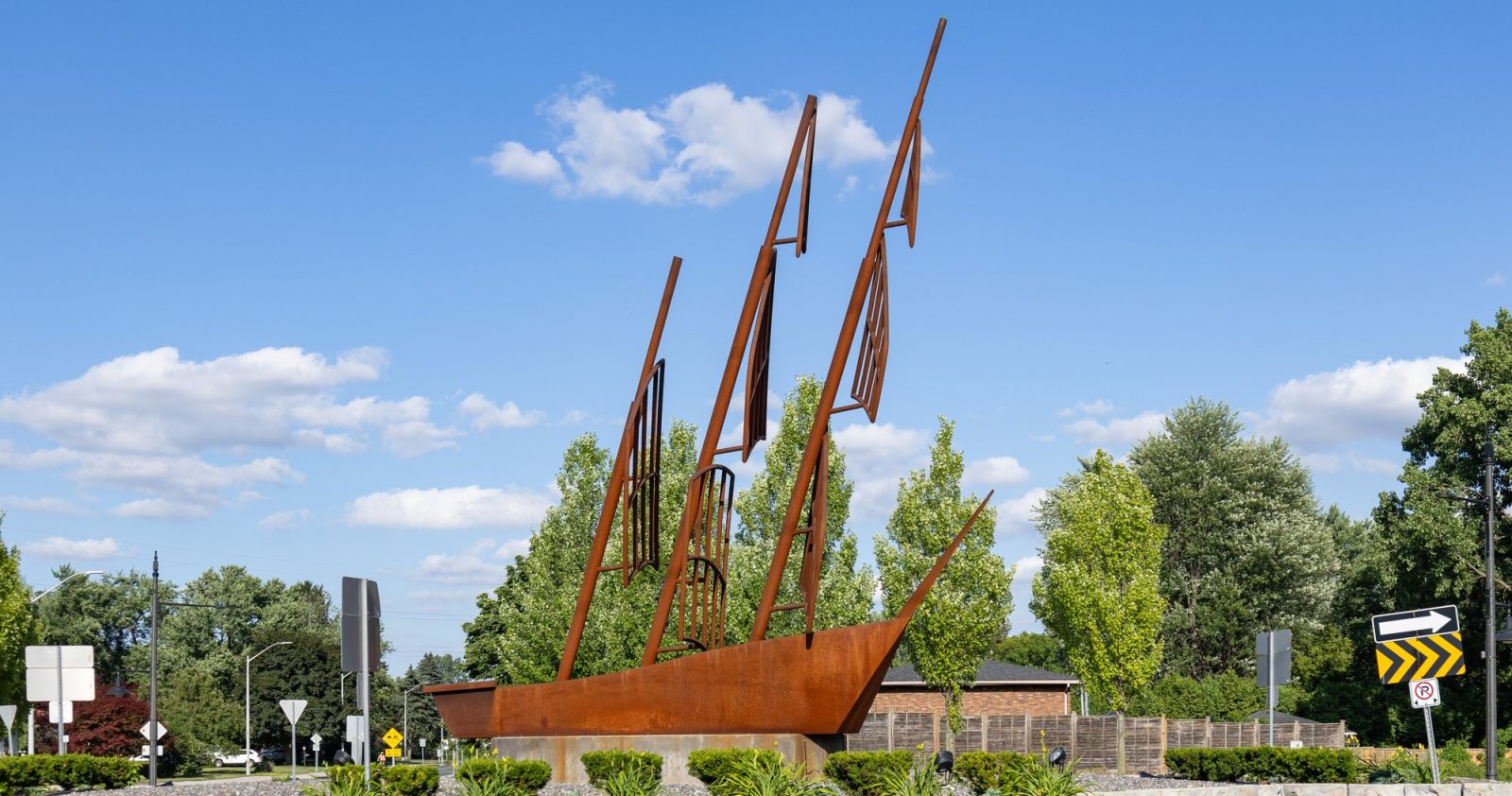
On the Canadian side, the town of LaSalle, Ontario, near Windsor, has a large steel sculpture of Le Griffon at the Malden Road roundabout. It’s the ship in the photo at the top of this post: an open, rust-colored silhouette, sails and all, which feels about right for a ship nobody has seen in nearly 350 years.
The ship that left a blank
What makes Le Griffon haunting isn’t a sighting. It’s the gap. A ship sailed out of a bay in the fall of 1679 with six men and a hold full of furs, and the record just stops. Into that gap, over the centuries, people have poured storms, treachery, a curse, a ghost ship in the clouds, and more than twenty “discoveries.” Some of it is history, some of it is guesswork, and some of it is folklore. Maybe someday a diver will finally find her timbers. Until then, the first ship lost on the upper Great Lakes is still out there somewhere, mostly in the stories.
Sources: Louis Hennepin, A New Discovery of a Vast Country in America (1698 English edition); David Calnan, The Northern Mariner (2013); Marie Caroline Watson Hamlin, Legends of Le Détroit (1884); Geri Rider, The Ghosts of Door County (1992), via W-Files; Lake Effect Living; Detroit Free Press; Door County Pulse; Discover Magazine; Wikipedia.
Top image: The Le Griffon sculpture at the Malden Road roundabout in LaSalle, Ontario, June 2025. Photo: Chris Woodrich, CC BY-SA 4.0, via Wikimedia Commons