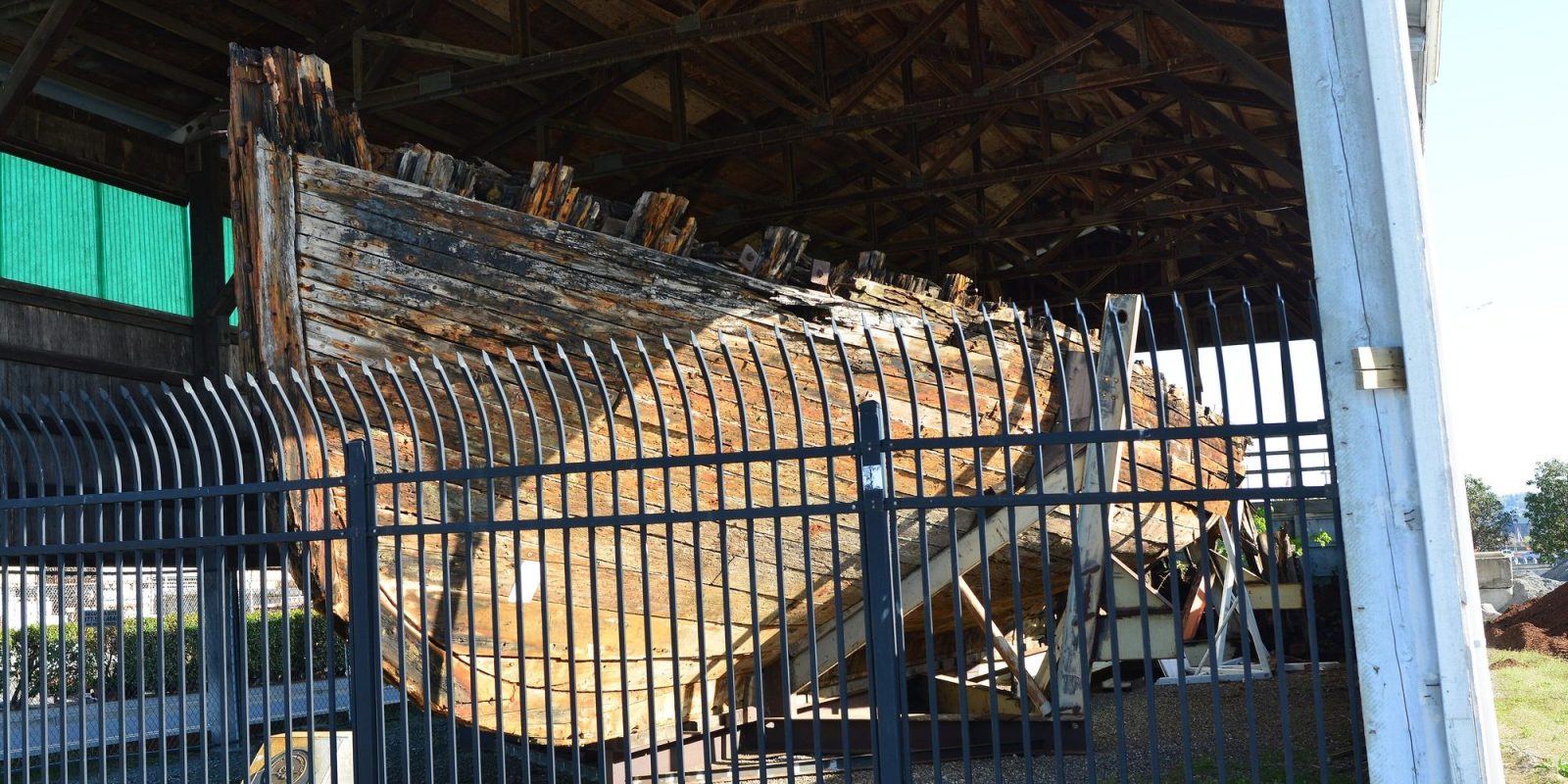
For more than half a century, a lot of people driving along the Everett waterfront passed something odd without realizing it: a gray, ribbed wooden hull, no masts, sitting on blocks under a shed at the corner of 10th Street and Craftsman Way. The hull was the Equator, a schooner that once carried Robert Louis Stevenson through the South Seas. By the end she was a ruin, and like most ruins she picked up a ghost story along the way.
Then, in 2023, she was taken apart, plank by plank. So this is a slightly unusual ghost-ship post. It’s about a real ship with an unusually long and busy life, a haunting that rests on a single sentence, and what happens to a ghost ship when the ship itself is gone.
A schooner from Matthew Turner’s yard
The Equator was built in 1888 by Matthew Turner, the California shipwright whose yard at Benicia, on the north shore of the Carquinez Strait, turned out more sailing vessels than almost anyone in America. The Washington Trust for Historic Preservation credits him with 228 seagoing vessels over 37 years, 133 of them two-masted schooners like this one. She was a “pygmy” trading schooner built for the Wightman Brothers of San Francisco, meant to carry people and cargo around the Pacific islands. A 2024 article in the International Journal of Nautical Archaeology says she worked as a Pacific merchant ship until 1895, and along the way rode out a tropical cyclone that made headlines around the world.
Stevenson’s charter
Her claim to fame came in 1889. Robert Louis Stevenson, already famous for Treasure Island and Strange Case of Dr Jekyll and Mr Hyde, was traveling the Pacific for his health with his wife, Fanny Vandegrift Stevenson, and her family. He chartered the Equator for a trip from Honolulu through the Gilbert Islands in what is now Kiribati, and on toward Samoa, where he would eventually settle and spend the rest of his life.
The Everett waterfront’s historical program says Stevenson came up with the idea for his novel The Wrecker, written with his stepson Lloyd Osbourne, and started writing it while aboard. Texas A&M University, more cautiously, says scholars think the voyages “may have inspired” The Wrecker and his travel book In the South Seas.
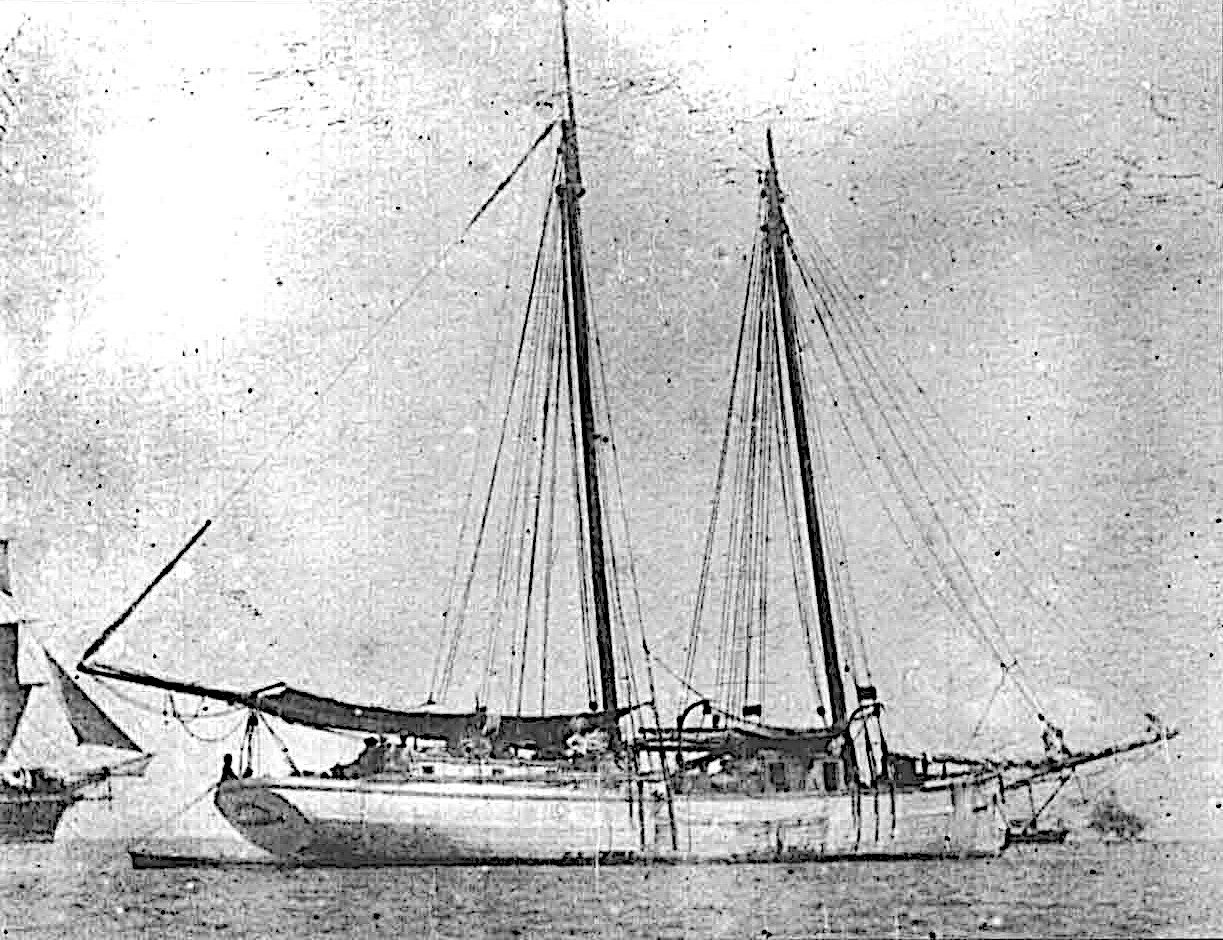
The photo above, from a federal historic-engineering record, shows the Equator at Apia, Samoa. The record dates it December 1899. Stevenson’s voyage ended in Samoa in late 1889, so it’s possible the year is a typo, but I couldn’t confirm that either way, and I’ve left the date as the record gives it.
Many lives: tender, survey ship, tug
After Stevenson, the Equator went to work, and kept working for most of the next sixty years. The details vary depending on who’s telling it. The Everett waterfront program says she got an engine in 1893; sculptor John Grade’s studio, which salvaged her timber, says she became a steam schooner in 1897. Either way, she ended up as a tender, serving an Arctic whaling fleet and salmon canneries in Alaska.
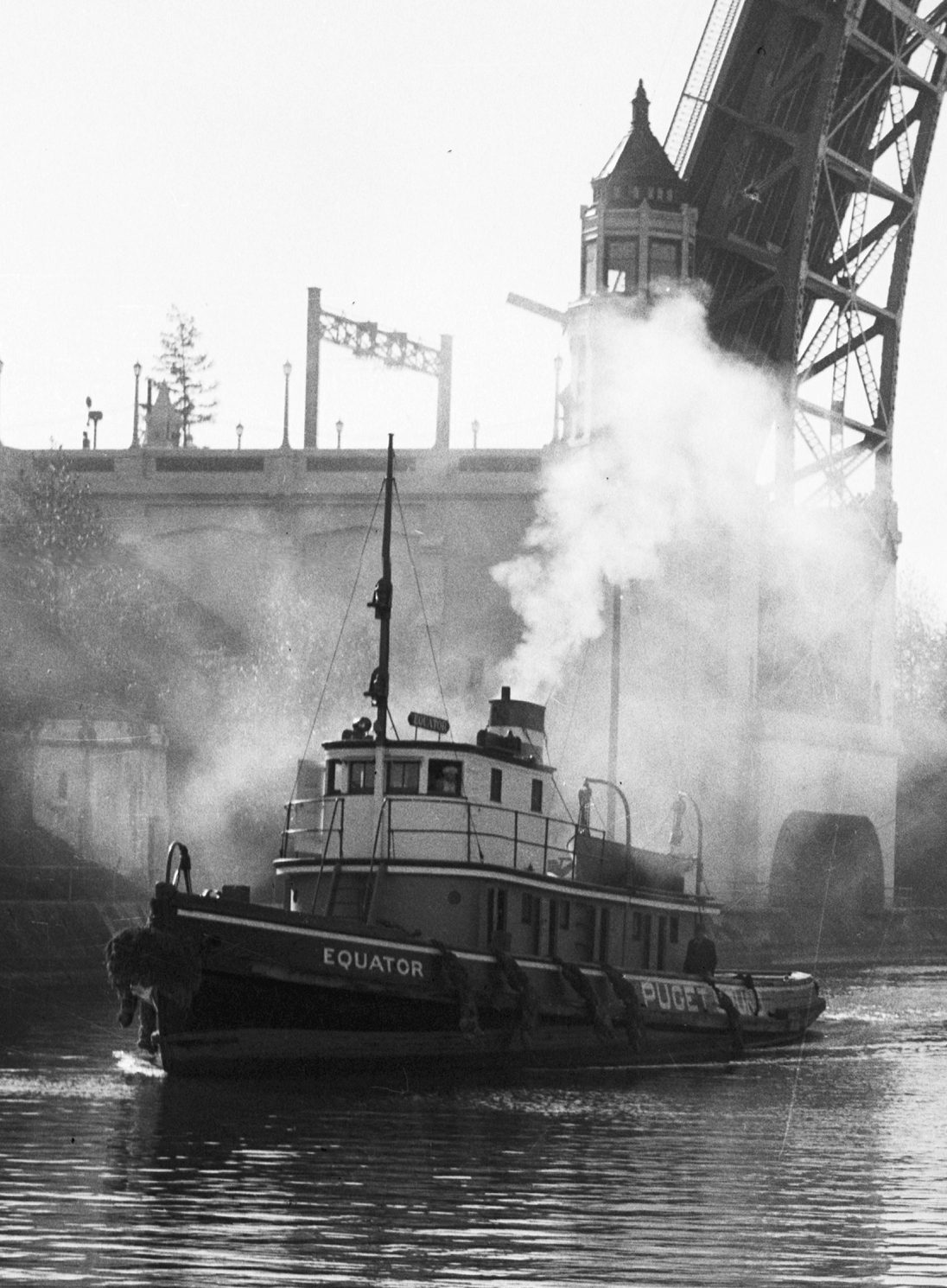
In 1915, according to Grade’s studio and Wikipedia, she was chartered by the U.S. Coast and Geodetic Survey for wire-drag survey work in Southeast Alaska. In wire-drag surveys, two boats towed a long submerged wire between them to find rocks and wrecks that soundings had missed. She was rebuilt in 1923 and spent the rest of her working life as a tug on Puget Sound, towing larger vessels and log rafts. The Port of Everett’s CEO, Lisa Lefeber, put it this way in 2023: the schooner Stevenson chartered “spent most of her life as a humble Puget Sound tug.”
The breakwater and the rescue
By the mid-1950s she was worn out. According to the Everett waterfront program, the week of August 15, 1956, she was left at the Port of Everett’s Jetty Island as part of a breakwater, one more discarded hull in a line of old vessels holding back the water.
She stayed there for over a decade. Then a local dentist named Eldon Schalka decided she deserved better. The week of June 26, 1967, he led the effort that pulled her out of the breakwater. He and Dick Eitel, who stored the hull at his Fishermen’s Boat Shop on 14th Street, were central to the Equator Foundation, formed to restore her. Schalka’s dream, the program says, was to see her seaworthy again.
There was real momentum. On April 14, 1972, the Equator was added to the National Register of Historic Places, the first property in Everett to get that designation. The Port calls it the first in Snohomish County. But restoring a wooden ship costs a fortune, and the money never came. When Schalka died in a plane crash, the Port says, the campaign lost its driving force. In 1980 the hull was moved to the Port’s new Marina Village, and later to the shed near the 10th Street boat launch, where people would know it for the next few decades.
The ghost story
This is where the haunting comes in, and it’s short. In a piece called “The Lives (and Afterlives) of Everett’s Haunted Schooner Equator,” the Washington Trust for Historic Preservation, also republished by Maritime Washington, wrote:
Left to its ghosts, the Equator was said to be visited by dancing lights above the hull at night, and psychics reported that those lights were the ghosts of Robert Louis Stevenson and his friend, Hawaiian King Kalakaua.
That’s the whole legend, as far as I can find. There are no named witnesses, no dates, no description of what the lights looked like, and no indication of who the psychics were or when they made their claim. I searched online for other accounts, ghost-tour listings, and paranormal write-ups about the Equator or the Everett waterfront and found nothing that adds to that one sentence. So treat it as exactly what it is: a single, unsourced line of local lore.
The choice of ghosts is interesting, though. Stevenson really did befriend KalÄkaua, the last king of Hawai’i, in Honolulu in 1889, the same year he chartered the Equator. Whoever first told the story knew the ship’s history. Neither man ever set foot in Everett, and the Port itself notes that Everett “has no direct link to the Equator during her service years.” Her connection to the city is the half century she spent on display there.
Taken apart
By the 2010s the hull was in bad shape. In November 2017 the stern collapsed, and the Port enclosed the shed to slow the decay. She was also legally an “orphan.” Nobody could show they owned her. In 2022 the Port posted notices on her bow giving any owner until May 29 to come forward, prove ownership, move the vessel, and pay the costs. No one did, and the Port took custody.
In June 2023, nautical archaeologists and students from Texas A&M University spent about two weeks documenting her with measurements, photographs, laser scans, and timber samples. “This is a form of preservation, forever,” Professor Piotr Bojakowski said, according to the Washington Trust. About 300 people came to the Port’s open house that June to see her one last time. That September, crews began taking her apart, and Grade’s studio says it finished salvaging her wood in early 2024.
Visiting
There’s no hull left to visit. What’s left of the Equator is in records, research, and reused wood. In 2023 the Port of Everett announced an interpretive exhibit at its Waterfront Center, 1205 Craftsman Way, near the inside entrance to Scuttlebutt Family Pub. It was to include historical photos, a timeline, a map of her voyages, and a 1:48 model of the ship loaned by modelmaker Robert Yorczyk. The Port’s newsletter also reported that a ship-themed children’s playset in her honor was being installed at Jetty Landing Park, near the boat launch, in August 2023. I haven’t confirmed that either is in place today, so check with the Port before making a special trip. The Everett Waterfront Historical Interpretive Program website has more of her history.
The afterlife
The ending I like best is the sculpture. The Port commissioned Seattle artist John Grade, whose earlier work includes a sculpture made from the hull of the historic schooner Wawona, to turn some of the Equator‘s salvaged timber into a piece for the entrance of the Port’s offices. His studio’s website says it will be installed in early 2026. I couldn’t find an announcement that it has gone up, so it may be finished, or it may still be on its way.
Maybe that’s the honest version of the Equator‘s ghost. Not lights dancing over a rotting hull, but a 19th-century schooner that sailed with Stevenson, towed logs on Puget Sound, sat in a breakwater, spent half a century as a waterfront ruin, and came back as something new.
Sources: Port of Everett; Port of Everett Portside, Summer 2023; Everett Waterfront Historical Interpretive Program; Washington Trust for Historic Preservation; Maritime Washington; My Everett News; Texas A&M University; “The Many Lives of Equator” (2024); John Grade Studio; Wikipedia.
Top image: The hulk of the schooner Equator in its shed in Everett, Washington, April 2023. Photo: Joe Mabel, CC BY-SA 4.0, via Wikimedia Commons